


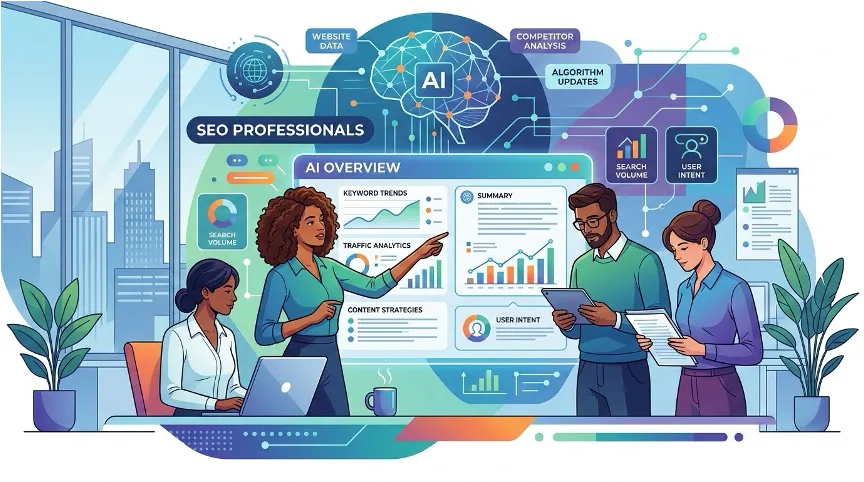
For the first time in over a decade, SEO professionals are questioning whether the domain decisions they made years ago are still working in their favor. The reason comes down to a fundamental shift in how search engines process and present information.
Google AI Overviews now answer user queries directly at the top of the results page, heavily reducing the click-through opportunities for many organic results.
Brand visibility, organic traffic volume, and long-term authority are all going through a major recalibration. For business owners and marketing teams, this means adapting to a new search environment.
By reading this guide, you will understand exactly what changed in search behavior, what domain signals still matter, and how you can make smarter, more resilient decisions moving forward.
Why a Strategic Domain Name Search Is the First Step to AI-Era SEO Resilience?
With AI Overviews intercepting a growing share of informational queries, the decision about where and how to build your brand online has never carried more strategic weight.
Conducting a thorough Domain Name Search—one that accounts for brand clarity, memorability, and authoritative trust signals—is increasingly the foundation upon which robust, search-resilient brands are built.
In the past, marketers often chased exact-match keyword domains to quickly rank for specific search terms. Today, brand-match domains perform significantly better in an AI-driven search landscape.
Search algorithms increasingly prefer surfacing authoritative, recognizable brands over pages stuffed with keywords.
When a search engine’s artificial intelligence compiles an answer, it looks for trusted entities. Building a strong brand identity starts with your name and your top-level domain (TLD).
Think of your domain choice as an upstream decision with serious downstream SEO consequences. Choosing your business name and finding the right domain extension is a strategic investment rather than a mere administrative step.
What AI Overviews Are Doing to Search Behavior — and Why Marketers Should Care?
To understand how to adapt, we first need to look at how AI Overviews work and what they have changed. The search industry is moving rapidly from click-driven search to answer-driven search.
Instead of offering ten blue links for a user to click through, search engines synthesize information from multiple sites into one cohesive paragraph directly on the results page.
This shift severely impacts the click-through rate (CTR) of informational queries. Zero-click searches are redistributing where traffic goes, putting additional pressure on direct traffic and branded searches. Businesses with weak domain authority or unclear brand identities are the most exposed to this drop in traffic.
Here are 4 ways AI Overviews are reshaping organic search:
- Shrinking real estate for organic links: AI Overviews push traditional organic results further down the page, meaning the top spots command fewer clicks than before.
- Increased value of direct brand searches: When users search for your exact company name, they bypass the generic AI summaries, making brand recognition more valuable than ever.
- Higher emphasis on entity trust: AI models source information from domains they classify as highly trusted entities, rewarding clean, established sites over newer, low-authority competitors.
- The rise of conversational queries: Users now type long, complex questions into search engines, requiring domains to have deep, comprehensive content to even be considered as a source.
Recent search reports indicate that Google AI Overviews now show up in nearly 55% of all Google searches, becoming a common part of everyday browsing. Also, around 50% of search queries in the United States now generate Google AI Overview responses.
Why Hosting, Site Speed, and Technical Infrastructure Now Carry More SEO Weight?
Your domain strategy does not exist in isolation. The technical environment surrounding your domain is increasingly part of how AI-powered algorithms assess site trustworthiness and quality.
Core Web Vitals, server uptime, page load performance, and mobile responsiveness are powerful signals that feed into how search engines evaluate your overall authority.
The infrastructure behind a domain matters as much as the domain itself — choosing reliable web hosting with consistent uptime, fast load speeds, and clean server architecture delivers the technical trust signals that modern search algorithms increasingly use to separate credible sites from the noise.
For business owners, connecting these dots is essential. Investing in strong infrastructure and data privacy is no longer just a technical decision; it is a brand and SEO decision.
If an AI crawler encounters slow load times or frequent server errors, it will rapidly categorize the domain as low-quality, regardless of how well-written the content is.
Clean, reliable infrastructure ensures that search engines can access, understand, and trust your domain without hesitation.
Domain Signals That Still Matter — and the Ones SEO Pros Are Prioritizing Now
While AI has changed the rules of the game, many foundational domain signals remain relevant. SEO professionals are simply reprioritizing how they weigh these factors. Here is what still matters in an AI Overview world:
Domain Age and History
Older domains with a clean history still carry weight. Search engines view longevity as a sign of stability. However, simply buying an old domain is not enough. The history must be clean, free from spam penalties, and contextually relevant to your current business.
Subdomain vs. Subdirectory Structure
How you organize your domain matters immensely. Keeping content within subdirectories (like yourdomain.com/blog) consolidates your domain’s authority much better than splitting it across subdomains (like blog.yourdomain.com). AI crawlers prefer to assess a single, unified entity.
ccTLD vs. gTLD for International Strategy
If you operate globally, your top-level domain choice remains a major ranking factor. A country-code TLD (like .uk or .ca) signals strong local relevance to both users and search algorithms. Conversely, a generic TLD (like .com or .org) is ideal for a broader, international approach.
Clean Backlink Profiles
In the past, marketers could manipulate rankings with sheer volumes of low-quality links pointing to their root domains. Today, AI is exceptionally good at spotting unnatural link patterns. A natural, highly relevant backlink profile tied to your root domain is an irreplaceable signal of trust and authority.
Traditional SEO prioritized keyword-in-domain strategies, where having a URL like “best-running-shoes-city.com” gave you an edge. Today, SEO professionals prioritize brand consistency, domain trust, and clean technical histories.
If you are a new business, choose a name that builds brand equity. If you are an established business, focus on cleaning up your technical infrastructure and reinforcing your brand identity.
Adapting Your Strategy for the Future
AI Overviews have moved the goalposts for search visibility. However, a well-planned domain strategy remains one of the highest-leverage, lowest-churn investments your business can make.
The rules of engagement have shifted from manipulating algorithms with keywords to proving your business is a legitimate, authoritative entity.
The businesses adapting fastest to these changes are those treating their domain and infrastructure decisions as central parts of their marketing strategy—not just as items on an IT checklist. Your domain name, your hosting environment, and your overall brand identity are deeply intertwined.
Now is the time to audit your current domain setup. Evaluate your technical performance, assess whether your domain clearly communicates your brand, and ensure your infrastructure supports rapid, reliable crawling. The right moment to act is before your organic visibility erodes, not after.
FAQs
How are AI Overviews affecting organic search traffic for business websites?
AI Overviews synthesize answers directly on the search results page, which reduces the number of users clicking through to individual websites. This primarily impacts informational queries, making it essential for businesses to drive direct brand traffic and focus on conversion-driven content.
Does your domain name still influence SEO rankings in an AI-first search environment?
Yes, but differently than before. Search engines now value domain names that establish a clear, trustworthy brand entity rather than domains simply stuffed with exact-match keywords.
What type of domain — brand-match or keyword-rich — performs better with AI Overviews active?
Brand-match domains perform significantly better. AI models look for authoritative, recognizable sources to pull information from, making a unique brand identity much more valuable than a generic keyword string.
How does web hosting quality affect SEO performance and search visibility?
Web hosting directly impacts your site speed, server uptime, and Core Web Vitals. Search engines use these technical metrics to gauge user experience and site reliability. Poor hosting can prevent AI crawlers from trusting or recommending your site.
Should businesses with older domains reconsider their domain strategy in 2025?
If an older domain relies heavily on exact-match keywords rather than brand recognition, it may be time to pivot. However, older domains with strong, clean histories and good brand alignment are highly valuable and should be optimized rather than abandoned.
