


Lean startups, remote-first IT managers, and budget-conscious tech leads all wrestle with the same question: how do we add senior-level engineering muscle without torching our burn rate or drowning in HR logistics?
Over the past decade, offshore partnerships have evolved from blunt cost-cutting tools into nuanced growth levers.
When done right, you gain 24/7 development velocity, reduced time-to-hire, and the ability to cherry-pick specialists you simply can’t find (or afford) at home. When done wrong, you inherit language barriers, hidden fees, and code you’re scared to deploy.
In 2026, the winners are those who treat offshoring as a strategic extension of their culture, not a disposable vendor line item.
Below, we break down the economics, compare popular staffing models, and profile five providers that combine value, transparency, and staying power, so you can scale with confidence rather than crossed fingers.
Why Offshore Staffing Still Matters in 2026?
Cloud-native stacks, AI copilots, and platform engineering have certainly boosted individual productivity, but they haven’t killed the talent gap. While junior talent is abundant, the industry faces a massive structural deficit for specialized roles.
Based on 2026 labor data, the U.S. alone is staring down a shortage of 1.2 million software and IT professionals, with the pressure most acute across high-performance systems, cloud infrastructure, and AI disciplines. For most young companies, paying Bay Area salaries for that skill set is existentially impossible.
That reality keeps offshore IT staffing in the spotlight. Yet the draw is no longer “half-price developers.” It’s speed and optionality:
- Sourcing cycles collapse from months to weeks.
- Legal, payroll, and compliance overhead disappear.
- Round-the-clock sprints allow startups to ship weekly instead of quarterly.
Most importantly, distributed teams inject fresh viewpoints. Diverse engineering cultures help uncover edge-case bugs and UX blind spots earlier, saving rework costs that would swallow any initial “savings” from cheaper labor.
Calculating Value: A Practical Framework
Before you sign an MSA, zoom out from the hourly rate and ask three questions:
- How many release cycles will I save? Shipping four weeks earlier can free up marketing windows or investor milestones that dwarf pure payroll math.
- What is my fully loaded cost of management? Time you or a senior engineer spend unblocking offshore teammates is time not spent on feature design.
- Will this partnership survive my Series B pivot? Look for partners who stay stable when your roadmap flips from MVP to multi-tenant SaaS.
Do the numbers across three scenarios – direct hires, traditional agencies, and dedicated-team models – and you’re running a true staffing model comparison. More on that later, but keep the framework handy as we meet the contenders.
Top Providers Worth a Second Look
If you need a deeper dive into market rates or legal frameworks, bookmark https://newxel.com/offshore-it-staffing/ for more profound insights. For now, let’s spotlight five vendors that consistently balance price, quality, and retention.
Newxel – European Engineering Without the Guesswork
Source: Newxel
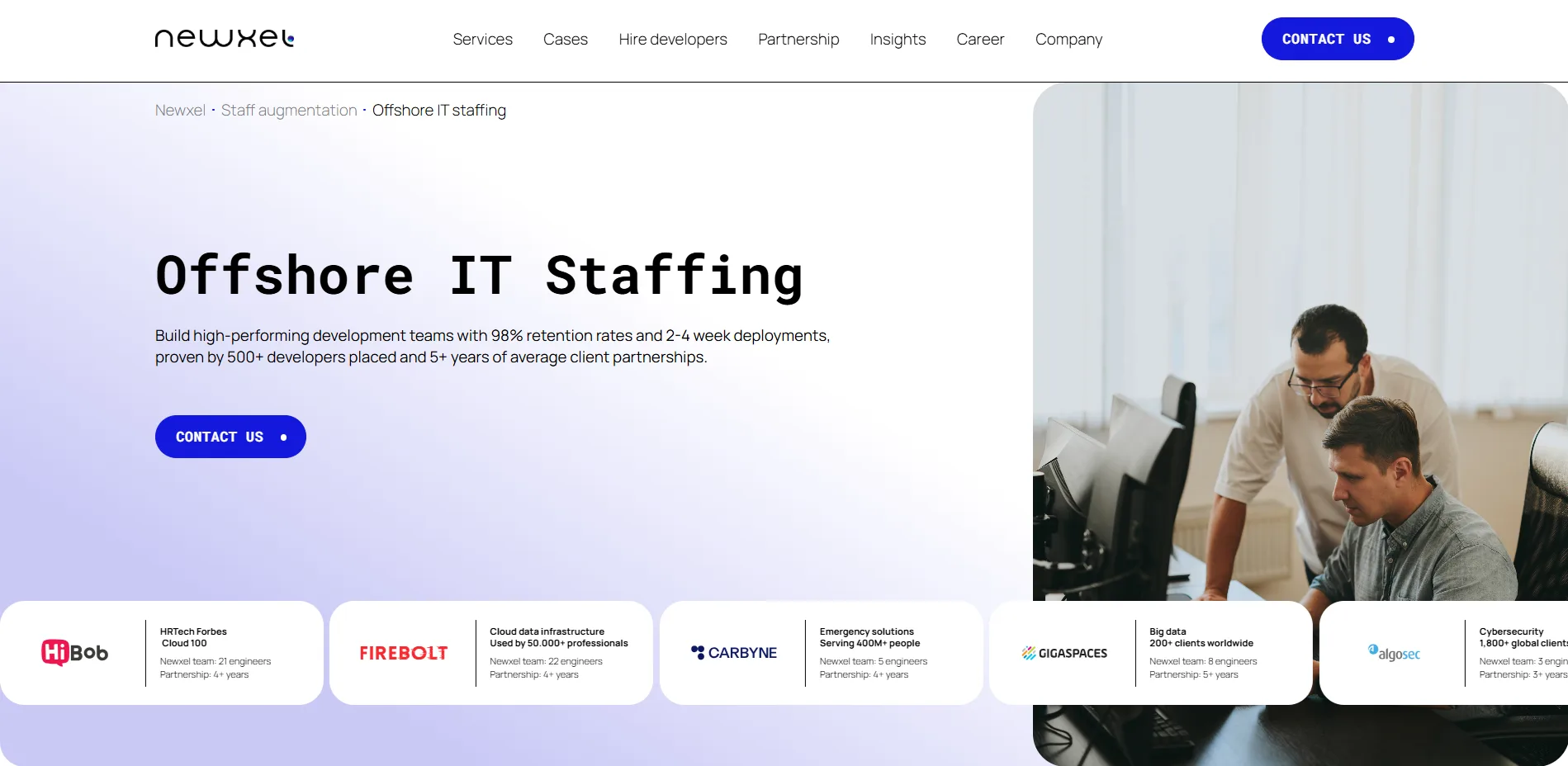
Born in 2017, Newxel treats offshoring as a managed operational layer, not just recruiting. Eight hiring hubs – Ukraine, Poland, Bulgaria, Romania, Turkey, Spain, Portugal, and Israel – feed a single, transparent pricing formula: developer salary × monthly rate, everything else included. HR, legal, equipment, and payroll: no line-item roulette.
Speed is another headline. A four-stage vetting process delivers shortlists in as little as two weeks, with an 85% offer-acceptance rate.
That means founders hire offshore developers while their competitors are still drafting LinkedIn posts. Even better, Newxel’s 98% long-term retention keeps tribal knowledge inside your product, not walking out the door.
Case studies back the hype: a 35-engineer core team for Renesas has run for seven years, while a 22-developer squad at Firebolt built features used by 50,000 data professionals.
In short, Newxel is the go-to when you want European cultural overlap and enterprise-grade stability without enterprise bureaucracy.
BairesDev – The Nearshore Powerhouse Across 14 Time Zones

Source: BairesDev
For U.S. and Canadian companies craving minimal latency, BairesDev leverages 4,000+ engineers drawn from 50+ countries worldwide, with the bulk of its talent rooted in Latin America.
Its “top 1% talent” mantra isn’t marketing fluff: out of nearly 1.9 million annual applicants, only a sliver survives English, technical, and soft-skill gauntlets.
Why does that matter? Because the right time zone plus fluent communication slashes stand-up friction, an overlooked cost in any staffing model comparison.
Clients like Google and Pinterest rely on BairesDev not just for staff augmentation but also for end-to-end builds. If you need SOC-2 level delivery with a Latin rhythm, this is your cue.
Softjourn – Domain Depth for Fintech and Live Events

Source: Softjourn
Sometimes breadth is overrated; you need a team that speaks your niche’s dialect. Softjourn focuses on fintech and media/event-ticketing platforms, wrapping 25+ years of institutional memory into each engagement.
Many staffers celebrate five-year milestones before going on to clock 15 or more years with the company, a retention stat that outshines competitors churning junior devs every nine months.
For founders in highly regulated or transaction-heavy spaces, Softjourn’s domain templates shave months off discovery and compliance cycles.
Think PCI-DSS nuances and real-time payment rails already baked into their codebase accelerators. Pair that with Ukraine- and Poland-based price points, and you have a boutique partner priced for startup balance sheets.
Tecla – AI-Assisted Matching Across Latin America
Source: Tecla
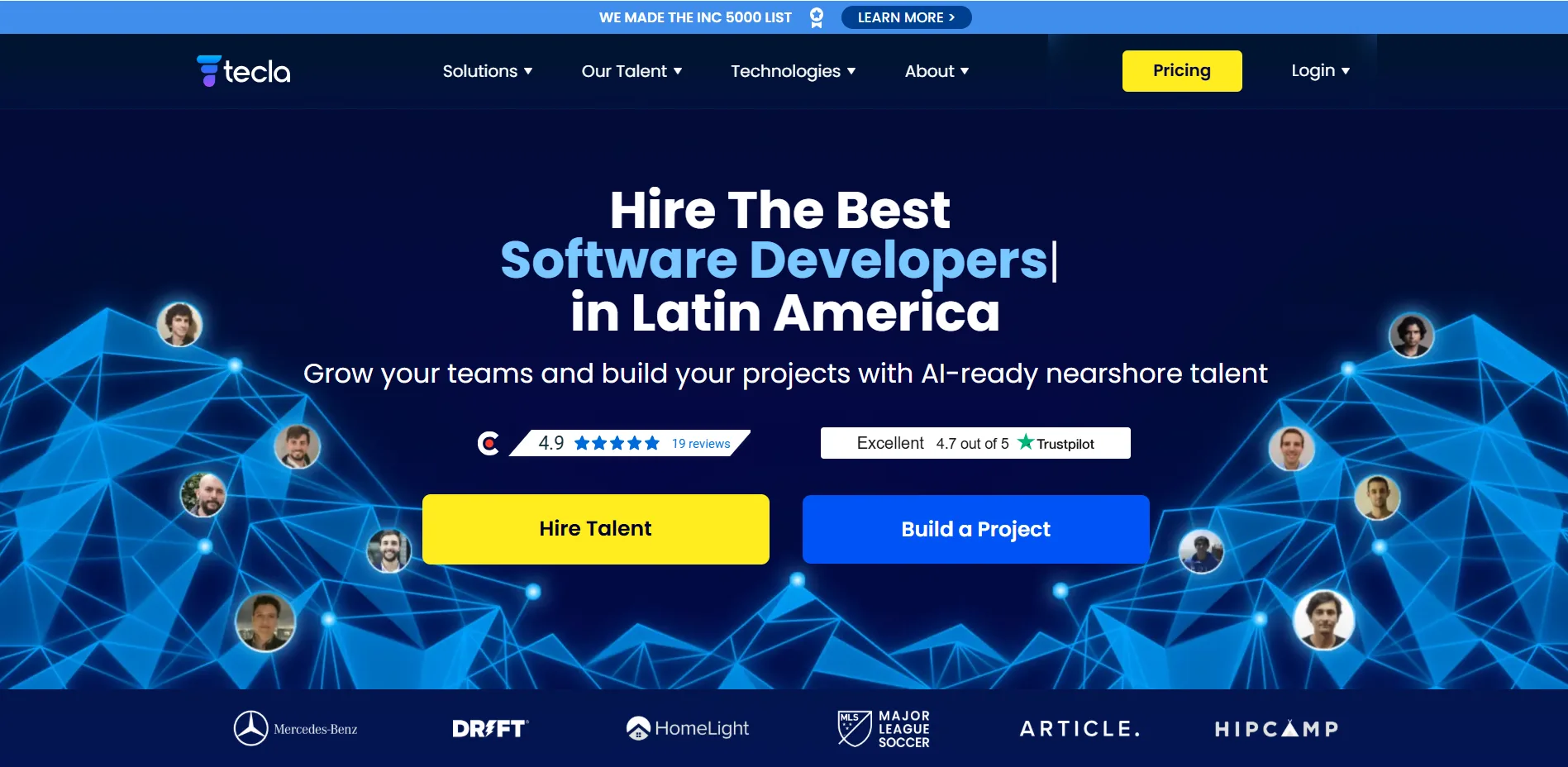
Tecla attacks the sourcing bottleneck with an AI screening engine spanning 50,000 pre-vetted engineers across 16 countries. The result: curated shortlists at rates from $15 to $70 per hour, wrapped in full legal and payroll compliance.
Startups often outgrow single-freelancer marketplaces because they lack governance. Tecla fills the gap with three engagement tracks: staff augmentation, managed agile squads, or fixed-scope delivery, so you can flip between models as fundraising ebbs and flows. If you’re comparing staffing models, that flexibility is a valuable asset.
Mphasis – Enterprise-Grade Hybrid Delivery for Regulated Industries

Source: Mphasis
Not every project is green-field SaaS. If you’re a fintech tackling FedRAMP or an insurer migrating COBOL workloads, you need mature processes and certifications.
Enter Mphasis, a 30,000-employee stalwart headquartered in Bangalore with onshore governance layers in major financial hubs.
Its Front2Back framework re-architects legacy stacks into cloud-native microservices while threading compliance controls throughout.
The hybrid on-shore/off-shore model is pricier than pure off-shore teams but cheaper than Big Four consultancies, making it a sweet middle ground.
For conservative boards, choosing Mphasis signals prudence without overpaying for a nuance that often tips the scales in executive-level staffing model comparison decks.
When to Hire Offshore Developers And When to Hit Pause?
Engaging a remote team isn’t always the right call. Below is a sanity check you can run before greenlighting the budget.
Green lights
- You have clear, modular backlogs (microservices, mobile clients, API integrations) that don’t depend on hallway chats.
- Code review and CI/CD pipelines are already automated.
- You can commit to at least one in-house lead as a product owner to prevent “requirements drift.”
Red flags
- The project is a pure R&D spike with rapidly shifting goals; daily pivots cripple distributed focus.
- Your startup culture values synchronous brainstorming over documented specifications.
- You lack the budget for overlap hours; even the cheapest devs cost more if every decision waits 12 hours.
Use this lens to decide whether to hire offshore developers now or invest first in process maturity. Skipping the introspection step is how companies burn cash on “cheap” talent that never ships.
Side-by-Side Staffing Model Comparison Cheat Sheet
Below is a quick framework you can adapt for your board deck. It highlights where each model shines and where it leaks value. Remember, any staffing model comparison is only as good as the assumptions you feed it.
| Dimension | Direct Remote Hire | Freelance Platforms | Dedicated Offshore Partner |
| Time-to-Hire | 6-12 weeks | 1-3 days | 2-4 weeks |
| Hidden Costs | Recruiting fees, local taxes | Turnover, variable rates | Minimal flat management fee |
| IP & Security | Fully controlled | Varied | NDA + provider’s security audits |
| Retention Risk | High (no local perks) | Very high | Low (partner handles HR) |
| Ideal Use Case | Long-term core team | Quick bug fix, POC | Scale-ups, feature teams |
Total cost of ownership shifts drastically once you factor in management overhead and rehiring churn. In many cases, a slightly higher hourly rate from a managed partner wins the staffing model comparison once you roll in the price of your own sleep.
The Hidden ROI of Cultural Alignment
Dollar savings are easy to measure, but harmony saves you twice: you avoid both rework and attrition. A recent Boston Consulting Group report found that when global organizations specifically structure their teams to overcome time zone delays and guarantee synchronous collaboration, the results are massive.
One Fortune 250 company leveraging this model achieved a 50% reduction in total implementation time and a 30% drop in downstream service requests. Providers like BairesDev and Tecla purposely straddle North-South American zones for this reason.
Conversely, European-based Newxel offers a cultural blend that often feels closer to Western agile rituals than you might expect.
The lesson: hire offshore developers whose skill set and skill set mesh with your roadmap. Cheap code that needs a daily rewrite isn’t cheap.
Future-Proofing Your Offshore Play
- Automate the Guardrails. Treat Terraform modules, linting rules, and DORA metrics as your first line of governance. Humans change; pipelines remember.
- Invest in Onboarding Videos. Async walkthroughs of architecture diagrams reduce the tyranny of time zones and scale better than live sessions.
- Promote Remote Leads. Elevate a senior offshore engineer to sprint lead within six months. It breeds ownership and halves your Slack pings.
These small changes don’t cost much but make a big difference in speed, which is a detail that is often missed in surface-level discussions about offshore IT staffing.
Making the First Move
Cheap does not mean cost-effective. It means paying the right amount for the right result. Whether you gravitate toward Newxel’s transparent European hubs, BairesDev’s time-zone magic, Softjourn’s domain mastery, Tecla’s AI-driven matches, or Mphasis’s enterprise rigor, remember the formula: alignment + retention + velocity > raw hourly savings.
Run your own staffing model comparison, validate culture fit, and pilot with a small cross-functional slice. If that slice ships quality code on schedule and the rapport feels natural, scaling to a full product squad becomes a financing decision, not an operational gamble.
The talent crunch isn’t going away, but neither is the global pool of brilliant engineers eager to join ambitious products.
Choose wisely, onboard intentionally, and the next time investors ask how you plan to double feature output without doubling spend, you’ll already have an answer and a world-class team to prove it.
