


Online casino access splits the country into sharply different realities. Players in states with legal frameworks choose from dozens of platforms, while those in restricted states hit hard walls set by local regulators, tax priorities, and political appetite.
This article breaks down the forces behind these gaps, pulling from revenue figures, player counts, and market trajectories across seven leading states, several partial-access models, and the many holdouts still saying no.
Players frequently search for online casinos available in Missouri to scale what might be possible in states still working through the debate.
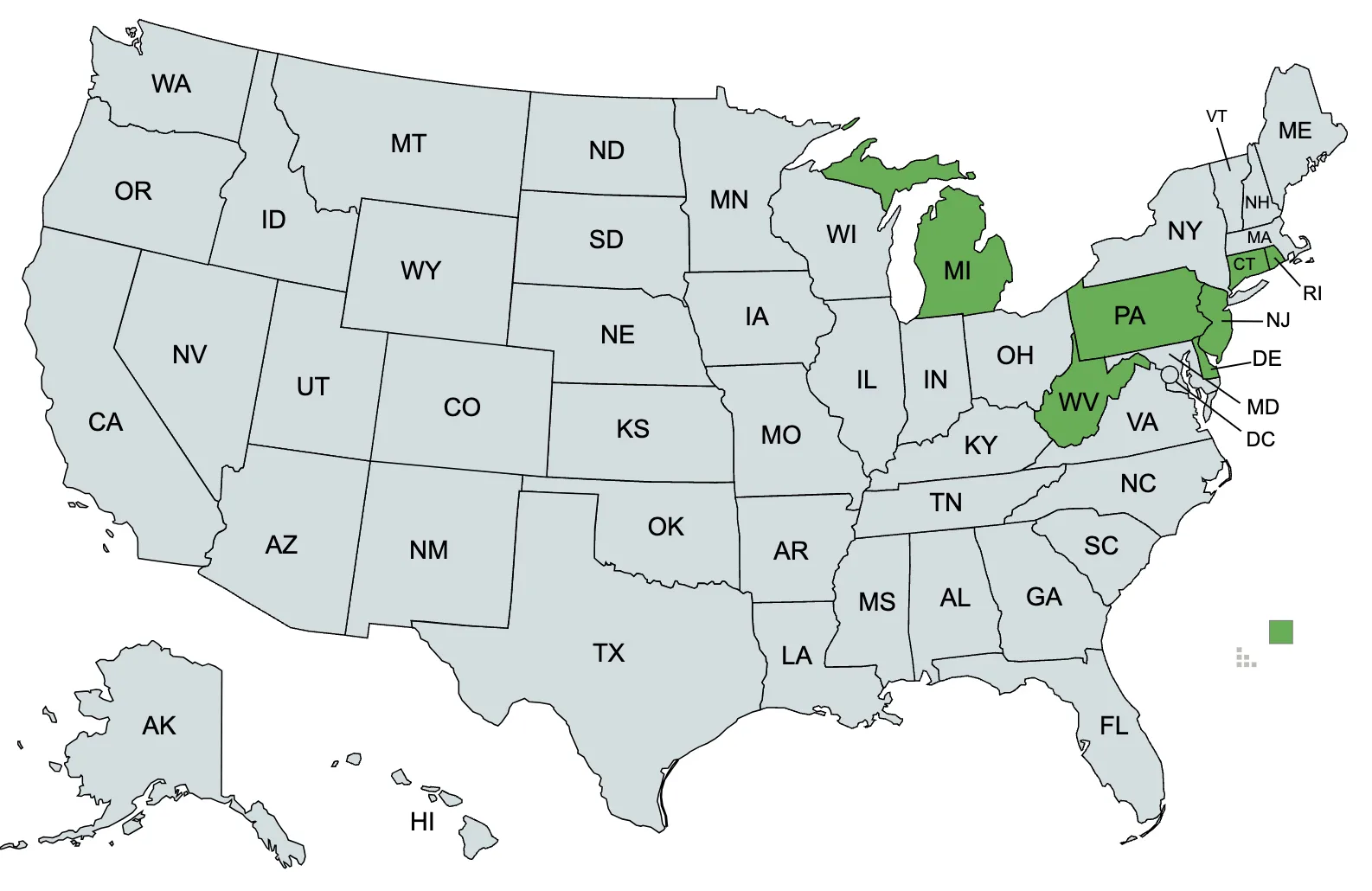
Pioneering States Forge the Path Forward
New Jersey regulators lit the national fuse when they approved the first fully regulated online casino market, growing it to over 1 million active player accounts that now generate $1.6 billion in annual revenue.
The state taxes player winnings at 3%, channeling proceeds into public programs while keeping operators competitive enough to hold that player base.
Michigan entered the space by leveraging its three land-based commercial casinos, pushing monthly gross gaming revenue past $150 million across more than 20 platforms offering slots, table games, and live dealer options. The state collects 8.1% of adjusted gross receipts, directing those funds toward infrastructure.
Pennsylvania went further still. Operators there recorded $1.7 billion in yearly revenue, with platforms like Fox Bet and DraftKings holding large, active user pools.
The commonwealth takes a striking 54% cut of gross revenue and sends it straight to education funding — proof that aggressive taxation does not necessarily kill market demand when the player base is large enough.
Surveys across these three states suggest roughly 60% of adults engage with online slots or table games, keeping operator competition high and pushing platforms to sharpen their game libraries and promotional structures under strict licensing requirements built around fair play.
Partial Access Models Take Root
West Virginia stepped in when Mountaineer Casino partnered with DraftKings, opening a market that now produces $100 million in annual revenue under a clean 15% operator tax.
Players there access slots, blackjack, and poker through apps built for mobile play.
- West Virginia: Partnered with DraftKings via Mountaineer Casino; $100M annual revenue at 15% tax; mobile apps for slots, blackjack, poker.
- Delaware: State-run monopoly via three casinos; ~$50M/year through a single platform for tight oversight.
- Rhode Island: Exclusive Bally’s license; $20M in first full quarter at 18.5% tax, funding housing programs; avoids crowded market.
- Connecticut: Tribal-powered (Foxwoods/Mohegan Sun) apps like Play SugarHouse; $250M last year with shared player pools for better variety/limits.
Emerging Opportunities and Ongoing Restrictions
Indiana lawmakers recently moved legislation that would expand sports betting into full online casino territory, with projections pointing to $500 million in revenue once operators like FanDuel complete their launches.
The player demand is already established through sports wagering — adding casino products is widely seen as a natural extension.
Ohio is taking a more measured pace, building on its retail casino base before approving online slots. State forecasts expect around 70,000 monthly active users at launch, contributing to local government budgets through tiered tax structures built to scale with volume.

The holdouts have reasons beyond ideology. The American Gaming Association tracks roughly 2.5 million problem gamblers nationally, a figure that weighs on legislators considering expansion.
States that do regulate online play now require age verification, self-exclusion databases, and spending controls.
Regulators are also explicit about house math — slots carry edges between 2% and 10%, meaning the operator advantage is structural, not incidental, and games are positioned as leisure rather than income strategies.
Sweepstakes platforms like Chumba Casino fill the gap across roughly 40 states by using virtual coin systems for redeemable prizes instead of direct cash wagers.
This structure sidesteps real-money gambling laws without violating them, giving players in prohibition states access to casino-style games through a legal workaround.
Some players in restricted states also explore offshore frameworks through Anjouan-licensed casinos on SlotsUp when looking at international casino options.
A few figures worth keeping in mind:
- New Jersey sustains 1.2 million dedicated players, anchoring its market lead
- Michigan has grown player engagement 25% year over year
- Pennsylvania generates $140 million in monthly revenue
- West Virginia applies a flat 15% operator tax
- Sweepstakes models now reach players in roughly 80% of U.S. states
What Comes Next?
The U.S. Supreme Court’s ruling on sports betting gave individual states the authority to create their own gambling regulations. As a result, online casino markets have continued to expand across the country.
States that have legalized online gambling have seen significant tax revenue, often allocated to education, housing, and infrastructure.
However, lawmakers must carefully weigh these financial benefits against potential risks, including gambling addiction, regulatory implementation costs, and broader social or political concerns.
A player should always check if online betting is allowed where they live – rules can differ wildly from one state to another. Since nearby areas might treat it completely differently, looking up local guidelines matters a lot.
Think of online casino games like a movie or concert – they’re meant to be fun, nothing more. The odds always lean toward the operator, thanks to numbers baked into each game. Take blackjack – it gives the house about a 2% upper hand on average.
Slot machines? They can tilt things by as much as 10%. That small shift adds up, ensuring the business stays ahead in the long run.
Where rules apply, safeguards often shape how people gamble. Things like capping deposits pop up now and then. Time checks slow things down, too. Losing money? It’s framed more like paying for fun – never something you get back.
One by one, states may keep opening up online betting. Instead of rushing in, lawmakers weigh extra taxes alongside possible downsides. Places like New Jersey, Pennsylvania, and Michigan? They’ve got rules running smoothly now.
Where it spreads next hinges less on tech – everyone’s got that – and more on local leaders choosing to move forward.
