


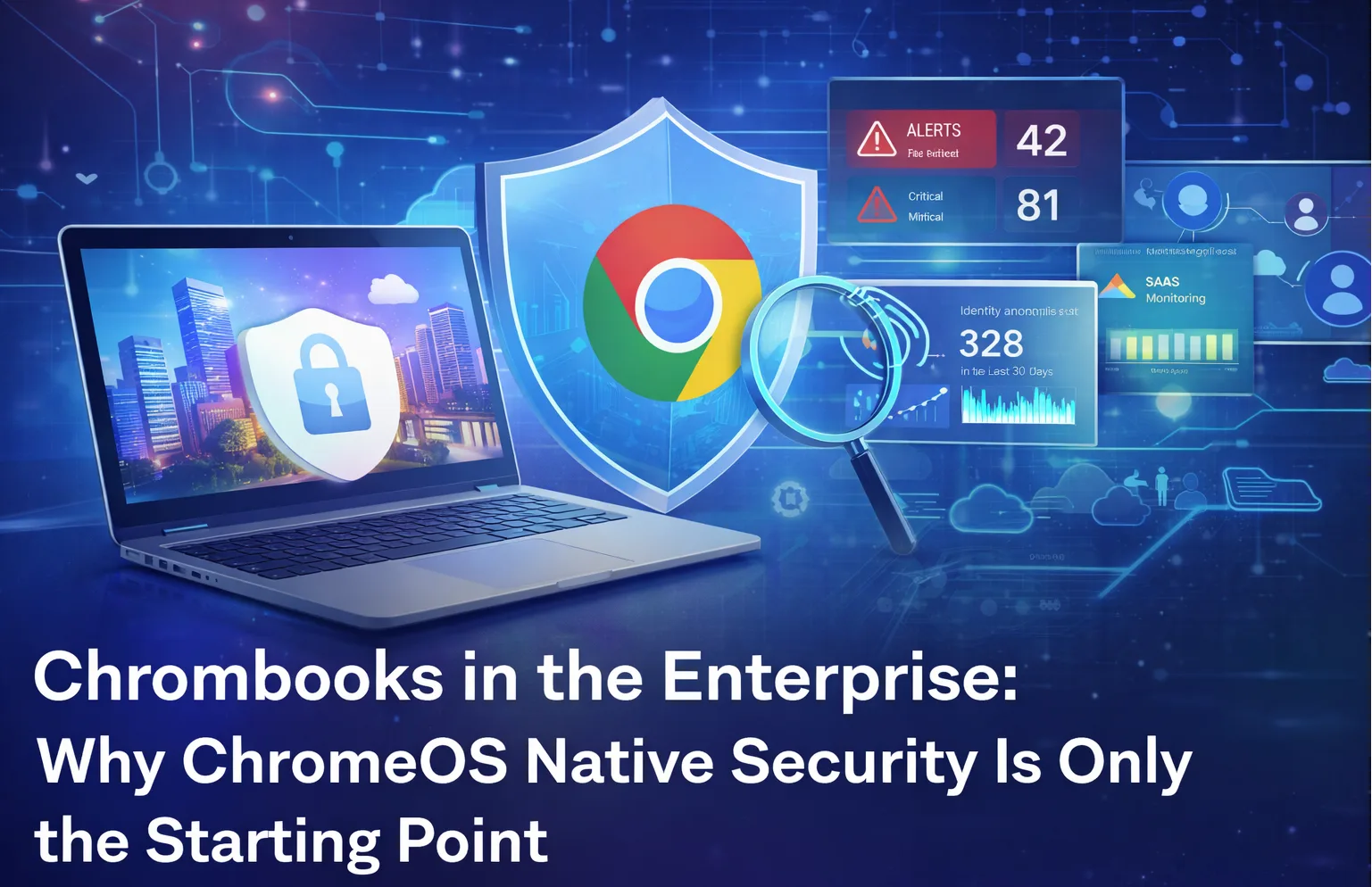
Chromebooks have steadily moved from classrooms and retail counters into mainstream enterprise environments.
For years, ChromeOS earned a reputation for being secure by design. Verified boot, sandboxed browser processes, and silent background updates significantly reduce traditional malware risk.
Many IT teams appreciate that ChromeOS devices require less hands-on intervention than conventional operating systems.
In controlled environments, those protections can be enough.
But enterprise security rarely breaks at the kernel level. It breaks at the intersection of users, identities, SaaS applications, and browser activity. As ChromeOS adoption expands across distributed workforces, that intersection becomes harder to ignore.
ChromeOS Security Was Built With Strong Foundations
Google’s design philosophy for ChromeOS centers around containment and integrity. The operating system verifies itself at boot. The browser runs in isolated processes. Updates apply automatically and frequently, reducing patch management friction.
The technical detail behind these protections is outlined in the ChromeOS Security Whitepaper, which explains how secure boot chains, sandboxing, and partition verification protect core system components.
For security engineers, it is an impressive blueprint. It demonstrates why ChromeOS devices are less susceptible to many traditional forms of malware.
This architecture made Chromebooks especially attractive in education and frontline environments, where IT teams needed predictable, low-maintenance systems. Devices could operate independently without extensive endpoint agents or heavy antivirus suites.
However, the threat landscape has shifted.
Modern Attacks Target Identity and Session Access
Today’s breaches rarely begin with kernel-level compromise. They begin with phishing campaigns, token theft, malicious browser extensions, and session hijacking. Attackers often bypass operating system protections entirely by targeting credentials and authentication flows.
ChromeOS cannot prevent a user from approving a malicious OAuth request. It cannot distinguish between a legitimate SaaS login and a compromised session token being reused from another location. When identity becomes the attack surface, the operating system is only one layer in a broader defense model.
Organizations using ChromeOS devices should be less concerned about traditional malware and more concerned about identity-centric threats. These attacks exploit browser sessions, API access, and cloud applications rather than device vulnerabilities.
That shift requires expanded visibility beyond native OS controls.
The Browser Has Become the Workspace
In many ChromeOS environments, the browser effectively is the desktop. Email, collaboration tools, CRM platforms, financial systems, and development environments all operate inside browser tabs.
Authentication flows rely heavily on single sign-on providers. Extensions add functionality and integrate third-party services.
This browser-centric model simplifies device management but complicates monitoring.
If the browser is the workspace, security controls must account for activity within it. Chrome Enterprise and Chrome Browser Cloud Management provide important administrative controls. They allow policy enforcement and extension governance at scale. They improve visibility into device compliance.
However, they are not designed to function as comprehensive threat detection systems. They do not provide unified detection and response across endpoints, SaaS applications, and user behavior patterns. They do not correlate signals between compromised credentials and abnormal browser activity automatically.
That is where organizations begin exploring broader controls.
From Device Security to Workspace Visibility
Security fragmentation becomes more noticeable as deployments grow. One console manages ChromeOS devices. Another handles identity providers. A third monitors SaaS usage. When an attacker gains access through a phishing campaign, these silos slow response.
A user logging in from a trusted Chromebook on an untrusted network can expose sensitive data without malware ever touching the device.
A malicious extension installed through social engineering can exfiltrate information while remaining invisible to traditional endpoint controls.
To address this gap, many enterprises adopt a workspace security platform approach. Instead of focusing solely on device integrity, this model monitors identity signals, browser behavior, and SaaS activity collectively.
The objective is not to replace ChromeOS protections, but to extend them into the user’s actual digital workspace.
For organizations standardizing on Chromebooks, this layered model aligns more closely with how employees work today.
Enterprise ChromeOS Deployments Are Evolving
The first wave of enterprise Chromebook deployments centered on cost efficiency and operational simplicity.
Education led the way. Retail and frontline environments followed. The reduced maintenance burden and automatic updates made ChromeOS attractive for distributed fleets.
Now, larger enterprises are adopting ChromeOS as part of broader digital transformation initiatives. Knowledge workers, hybrid teams, and global organizations are standardizing on ChromeOS alongside cloud-first application stacks.
As these deployments mature, security conversations change. IT leaders ask different questions. How quickly can we detect abnormal SaaS access? Can we contain session theft in real time? Do we have unified visibility into user behavior across managed devices?
These questions extend beyond native device protections. They reflect a shift toward identity and workspace awareness.
Extending ChromeOS With Broader Security Controls
ChromeOS remains a strong endpoint foundation. Its architecture reduces many legacy risks and simplifies fleet management.
But when organizations rely heavily on SaaS platforms and browser-based workflows, security must follow the user rather than the device alone.
This is where solutions like a workspace security platform become relevant in enterprise ChromeOS environments.
By integrating endpoint telemetry, identity context, and browser activity, organizations gain a clearer view of how resources are accessed and whether behavior aligns with expectations.
In practice, this means detecting anomalous logins across cloud applications, identifying risky extensions, and correlating suspicious activity across sessions. It also means reducing the time between compromise and containment.
Security teams no longer evaluate Chromebooks solely as endpoints. They evaluate them as entry points into cloud ecosystems.
ChromeOS Is the Foundation, Not the Finish Line
There is no denying the value of ChromeOS native protections. Verified boot, sandboxing, and automated updates provide meaningful risk reduction. They lower exposure to many traditional threats and simplify operational overhead.
But enterprise security rarely fails because the operating system was poorly designed. It fails when attackers exploit identity gaps, session management weaknesses, and fragmented monitoring.
As ChromeOS adoption expands in medium and large enterprises, the security model must evolve accordingly. Device integrity remains important. So does visibility into how users interact with applications, extensions, and authentication systems.
Chromebooks have changed the baseline for endpoint security. The next stage of enterprise protection builds on that baseline by extending awareness into the workspace itself. For organizations embracing ChromeOS at scale, that broader perspective is becoming essential.
