


This article answers:
- Why do legacy estates threaten both growth and compliance in 2026?
- How did we assemble the legacy modernization company list that follows?
- Which eight vendors stand out today, and what measurable value did each deliver?
- What modernization patterns are working now, from API-wrapping to staged strangler-fig replacement?
- How can CTOs compare top legacy modernization companies on integration depth, cost control, and security posture?
Introduction
Large enterprises once treated mainframes and on-prem ERP suites as sturdy assets that would outlive several product cycles.
That era is over. Today, customers expect weekly feature drops, regulators demand granular audit trails, and AI models require clean, real-time data feeds.
A brittle monolith running on end-of-life hardware cannot keep up. Forward-looking CIOs, therefore, partner with a legacy system modernization company rather than stretch another year of maintenance out of an aging stack.
Market projections confirm that global spending on application modernization is accelerating rapidly. According to Grand View Research, the modernization services market is projected to reach $52.46 billion by 2030, growing at a robust 16.7% CAGR.
Spending is no longer confined to technology verticals; manufacturers, insurers, utilities, and even public-sector agencies are funding multi-year programs aimed at replacing or re-architecting systems originally deployed in the late 1990s.
For CTOs, the main concern is choosing the right vendor among hundreds of legacy enterprise system modernization firms now crowding the market.
This guide distills our research into eight partners that repeatedly deliver measurable results without exposing clients to unnecessary risk.
Why Legacy Systems Need Modernization Now?
Organizations resist major platform change until the pain eclipses the perceived risk. That tipping point arrived when converging forces made delay untenable.
Cyber-exposure spiked: Verizon’s 2025 Data Breach Investigations Report (DBIR) revealed that the exploitation of vulnerabilities frequently tied to unpatched or outdated software surged to become the initial access point in 20% of all breaches, while ransomware featured in a staggering 44% of all confirmed cybersecurity incidents.
Talent scarcity worsened: CompTIA reported that only 14% of the U.S. developer workforce now lists COBOL or PowerBuilder competence, a decline of 9% in two years. Finally, the push toward GenAI intensified the demand for clean data streams integrated across the business.
Financial impact is quantifiable. Enterprise benchmarking by McKinsey & Company reveals that for legacy-heavy organizations, up to 70 percent of the total technology budget is consumed entirely by ‘run the business’ maintenance and mandatory operations, leaving just a fraction of OPEX for innovation.
If AI and data-product teams must wait months for a schema change, the value of advanced analytics plummets.
Legislators are equally unforgiving; the EU’s DORA framework prescribes specific recovery-time objectives that batch-driven systems cannot meet.
In short, modernization is no longer about chasing the latest technology; it is about keeping the business safe, compliant, and able to experiment at startup speed. Ignoring the problem inflates direct costs and blocks strategic initiatives.
Our Methodology for Ranking Legacy System Modernization Companies
Because every vendor marketing team claims to be “cloud-native” and “AI-enabled,” we constructed a transparent scoring rubric before drafting the legacy modernization company list.
First, we collected 42 contenders from analyst shortlists, industry awards, and independent customer referrals. A five-factor model then narrowed the field:
- Documented business outcomes (35%). Verified savings, risk reduction, or revenue growth publicly referenced by client stakeholders.
- Architectural versatility (20%). Ability to handle mainframe offloading, microservices re-architecture, data mesh enablement, and hybrid cloud at scale.
- Security & compliance maturity (15%). Presence of ISO 27001, SOC 2 Type II, or sector-specific certifications, plus a proven secure SDLC.
- Engagement transparency (15%). Road-mapping workshops, sprint metrics, and pricing baselines visible before contract signature.
- Innovation accelerators (10%). In-house frameworks, AI code-analysis tools, or migration kits that reduce time-to-value.
- Market recognition (5%). Gartner, ISG, or IAOP citations during 2023-2026.
We interviewed reference customers, inspected open-source repositories, and reviewed each partner’s public financial disclosures where available.
Only top legacy system modernization service providers that cleared the baseline criteria advanced to the final eight.
Top 8 Legacy Systems Modernization Companies in 2026
The following profiles summarize each vendor’s core modernization proposition, distinguishing assets, and market positioning.
They are ordered alphabetically. Before diving into individual firms, note that every partner earned its place on this legacy modernization company list by showing consistent results across multiple industries while maintaining clear road-mapping, cost governance, and security discipline.
Techstack
Source: Techstack
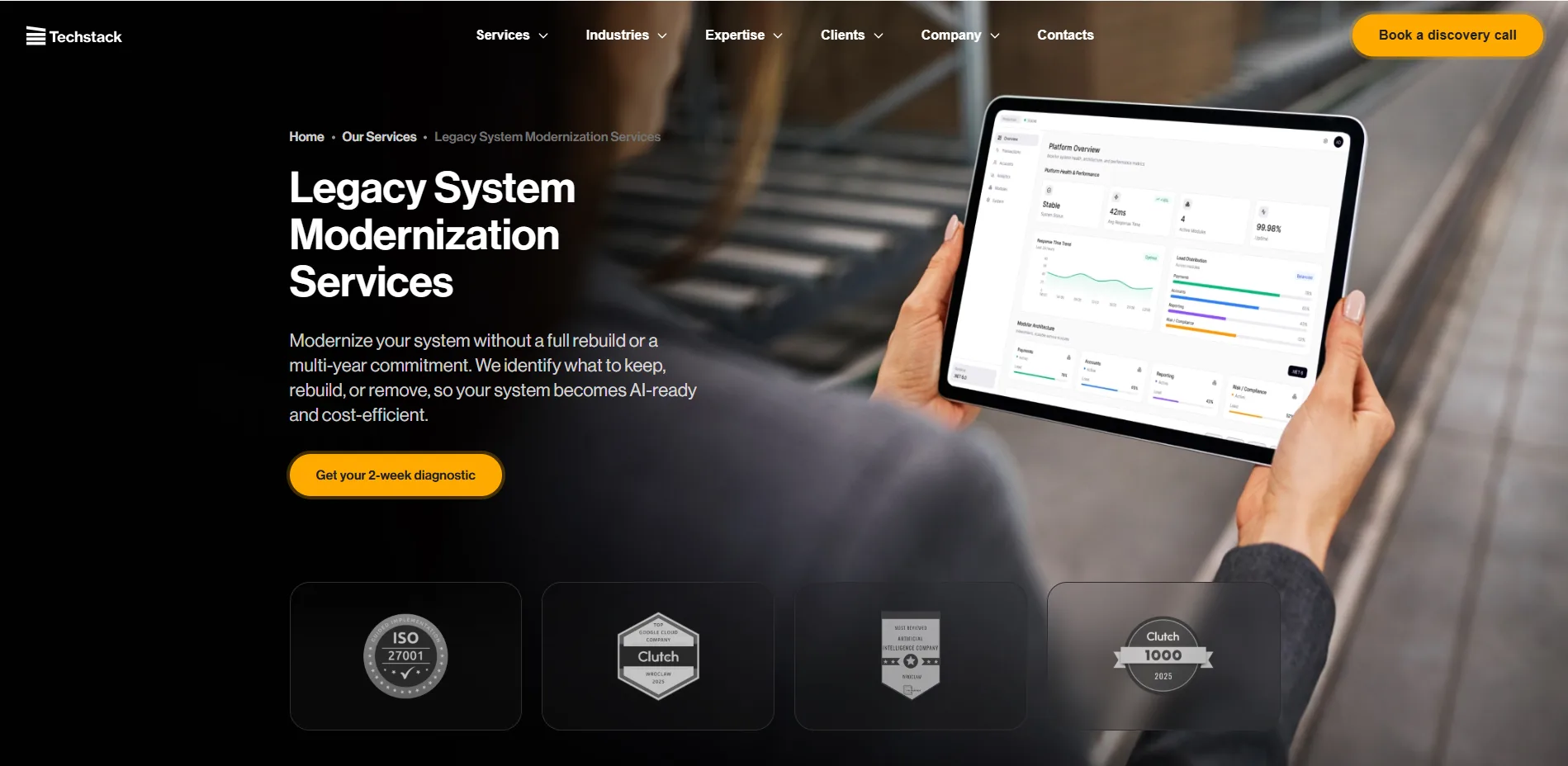
Techstack remains a frequent first call for CTOs coping with sprawling ERP footprints or a patchwork of custom .NET and Java services.
The company insists on a two-week diagnostic before prescribing solutions. We identify what to keep, rebuild, or remove, so your system becomes AI-ready and cost-efficient. From that single entry point, clients choose among three service tracks:
- AI Readiness Track. Audits data pipelines, evaluates API layers, and implements modular AI copilots without uprooting the entire estate.
- Cloud Migration Track. Plans and executes lift-and-shift or re-platforming to AWS, Azure, or GCP, including hybrid blueprints for systems that must stay on-prem.
- Full Modernization Track. Runs an incremental strangler-fig strategy, gradually rewriting or replacing modules while production stays live.
Techstack’s refusal to push a one-size-fits-all playbook appeals to executives burned by over-promised, under-delivered multi-year programs.
With its rapid diagnostic and quantified ROI roadmap, Techstack often short-circuits lengthy budget debates.
Steady growth and visible outcomes position it solidly among the best legacy system modernization companies in active competition today.
Grid Dynamics
Source: Grid Dynamics
Grid Dynamics is a U.S.-headquartered engineering powerhouse publicly listed on NASDAQ (GDYN). Its modernization stance treats transformation as a continuous operating model.
The firm employs AI-supported agents that open small, testable pull requests against legacy codebases, making incremental progress predictable.
Coupled with a Cloud Microservices Platform Starter Kit, this technique shortens the journey from monolith to Kubernetes or serverless stacks.
Retailers, banks, and streaming media platforms rely on Grid Dynamics to migrate off end-of-life Pivotal Cloud Foundry, Hadoop clusters, or VMware estates.
Pre-built blueprints, FinOps advisory services, and a global delivery network make Grid Dynamics a default inclusion whenever procurement teams compile a legacy modernization company list for competitive tender.
DataArt
Source: DataArt
Founded in 1997 and headquartered in New York, DataArt combines global scale – 5,700 professionals in 30+ locations – with deep vertical Advisory Groups in finance, travel, healthcare, and media.
Its modernization practice distinguishes sharply between total replacement (retire and rebuild) and gradual component retirement (sunset risk incrementally). This clarity helps regulated clients satisfy change-management auditors.
DataArt’s Snowflake Premier Partner status and recently launched Advanced AI Strategy Consulting Service prove that the firm links code refactoring with data and analytics enablement.
Awards from IAOP and the Financial Times reinforce its reputation among large enterprises selecting legacy enterprise system modernization firms able to carry programs from architecture to long-term managed support.
Devox Software
Source: Devox Software
Devox Software markets a proprietary AI Solution Accelerator™ that scans architecture diagrams, source control, and CI/CD telemetry to map dependencies upfront. That insight reduces blind spots before the first sprint.
Modernization services cover code refactoring, modular rebuilds, cloud migration, and intelligent automation layers.
The company’s focus on security, especially in regulated industries, is backed by a threat-modeling component built into the accelerator workflow.
Because Devox balances in-depth discovery with cost-governed execution, mid-market enterprises often place it high on their legacy modernization company list when budgets are tight but technical complexity is high.
The Software House (TSH)
Source: The Software House
TSH argues that modernization projects fail not due to old code but due to misaligned goals. Therefore, each roadmap item is tied to a defined business KPI.
Service coverage spans cloud-native migration, monolith decomposition, API-first re-architecture, and DevOps enablement. The company’s delivery centers in Poland and distributed teams across Europe and the U.S. give clients timezone overlap plus cost efficiencies.
TSH’s position as a firm specializing in legacy system modernization is reinforced by its emphasis on architectural governance: teams receive playbooks outlining when to adopt SaaS, when to build custom microservices, and how to phase retirement of brittle components. This advisory depth is a major differentiator.
Netguru
Source: Netguru
Netguru blends modernization with product thinking. Rather than treat back-end refurbishment as a siloed infrastructure task, the firm aligns code refactoring with UX improvements, data-strategy work, and go-to-market roadmaps.
Its heritage in fintech and retail means it is comfortable operating under PSD2, PCI DSS, and GDPR regulations while still moving fast.
Because the firm pairs modern DevOps practices with data-engineering capabilities, CIOs who want to clean data silos while upgrading the tech stack view Netguru as one of the top legacy modernization companies in EMEA.
Its Clutch Leader Award and Deloitte Technology Fast 50 Central Europe citations provide external validation.
CHI Software
Source: CHI Software
Operating since 2006, CHI Software has delivered more than 1,000 projects while maintaining ISO 27001 and ISO 9001 certifications.
Modernization services include refactoring, re-platforming, rebuilding, DevSecOps enablement, UI/UX redesign, and cloud migrations across AWS, Azure, and GCP. A structured discovery phase defines scope, risk, and outcomes before coding begins.
The firm’s Ukraine-rooted engineering talent, now broadly distributed across Europe, combines senior expertise with cost efficiency.
That makes CHI a logical choice for top legacy system modernization service providers sought by cost-conscious CIOs who still demand high-end security practices.
nCube
Source: nCube
nCube differs from traditional outsourcing models by embedding dedicated teams that integrate fully into client ceremonies.
Communication remains direct; there is no opaque intermediary PM layer. Modernization offerings include cloud re-platforming, monolith decomposition into microservices, and API-first design.
This engagement style gives clients more control and predictable run rates, which resonates with organizations wary of black-box outsourcing.
nCube’s promise to transform an entire tech stack within six months, without downtime, places it in many shortlists of top legacy system modernization companies for businesses wanting speed without chaos.
How Companies Modernize Legacy Systems?
Enterprise platforms rarely fall neatly into one modernization bucket. Instead, successful programs orchestrate multiple techniques to maintain uptime while evolving architecture.
A recurring theme among the eight legacy system modernization companies reviewed is a preference for incrementalism over “big bang” rewrites.
Before detailing individual patterns, the table below summarizes which techniques typically align with specific business drivers:
| Modernization Technique | Primary Driver | Typical Time-to-Value | Common Tooling / Platforms |
| API-wrapping / Facade Services | Rapid digital channel enablement | 1-3 months | Kong, Apigee, AWS API Gateway |
| Lift-and-Shift Replatforming | Data-center exit, license cuts | 2-6 months | AWS EC2, Azure VMs, GCP Compute |
| Strangler-Fig Decomposition | Controlled risk reduction | 6-18 months | Spring Boot, .NET 8, Kubernetes |
| Event-Driven Re-architecture | Real-time data distribution | 4-9 months | Kafka, Pulsar, AWS MSK |
| Automated Code Conversion | Shrink rare-skill dependency | 3-12 months | OpenRewrite, GPT-aided refactoring tools |
The table clarifies that no single method suffices; teams often sequence two or three techniques. An engagement might begin with a lift-and-shift to cut data-center costs, then segue into strangler-fig decomposition for high-value domains, and finally introduce event streaming for analytics workloads.
A critical capability shared by top legacy system modernization service providers is robust dependency mapping.
Without understanding how an AS-400 routine affects a modern CRM, even small changes can produce cascading failures.
Vendors such as Devox Software automate this analysis, whereas others rely on battle-tested manual playbooks.
How to Find the Ideal Legacy Modernization Partner?
Selecting among competing proposals can feel like comparing apples and oranges. Cost per hour, nearshore versus onshore staffing, proprietary accelerators, and SLAs vary widely.
Rather than default to the lowest price or the biggest brand, we recommend a weighted decision matrix focused on five dimensions.
Integration Capabilities
Legacy estates accumulate protocols – MQ, SOAP, proprietary socket calls – of heterogeneous types. Modernization partners need to show established trends in closing the gap between old and new and maintain low latency.
An example is Techstack, which has reference integrations of SAP PI, Tibco, and REST microservices that minimize design effort.
Data Preparedness
There is no use of a modernized application layer when data is siloed or dirty. Netguru and DataArt implement data governance as part of sprint plans, aligning the schema, lineage, and retention rules.
Some of the questions to be asked are: Does the vendor have in-house data engineers? What do they do to justify that the transformations are consistent with reporting KPIs?
Execution Excellence
Look for leading indicators such as defect density, mean time to restore, cycle time per feature, and automated test coverage.
Legacy enterprise system modernization firms with mature Agile practices provide real-time dashboards rather than static weekly PDFs.
Security & Compliance Standards
The modernization usually involves personally identifiable information (PII), monetary transactions, or medical records. Continuous security scanning is supported by partners such as CHI Software with ISO certifications.
Ensure your shortlist includes at least one firm specializing in legacy system modernization that can produce recent pen-test results.
Overall Cost Efficiency
The total program cost is the sum of labor expenditure and cloud run rate, licensing, test environments, and change-management overhead.
The dedicated team model at nCube can reduce the time and materials traditionally by 15-20% due to stable personnel and decreased staff turnover.
Meanwhile, Grid Dynamics compensates for the increased blended rates with ready-made microservices scaffolds that save months of delivery. Consider net present value, not sticker price.
Selecting a partner becomes easier once these five axes are quantified, turning subjective impressions into objective scoring.
Common Technical Obstacles in Modernizing Legacy Systems
Even the best plan encounters friction. Among dozens of modernization retrospectives we reviewed, five recurrent obstacles surface. Importantly, teams that anticipate these pitfalls install countermeasures early.
Tight Coupling to Proprietary Middleware
Orchestration, transformation, and routing are frequently combined in a single runtime by legacy message brokers. Unraveling those functions without stopping nighttime batch jobs requires gradual side-by-side deployments, feature flags, and contract testing.
Hidden Data Semantics
Siloed systems encode business rules in column names or character sets no longer remembered by the existing employees. Unless reverse-engineered correctly, it takes weeks.
License Lock-In Clauses
Other vendors impose shelf-ware charges despite the partial decommissioning. Procurement needs to negotiate exit clauses early in advance of the final cut-over.
Performance Regressions
Breaking down services may add network chatter, raising p99 latency. Top legacy modernization companies pre-compute service topology maps and introduce caching layers judiciously.
Change-Management Fatigue
Frequent user-acceptance testing cycles exhaust business users. Champions inside each department and staggered release cadences mitigate burnout.
Pragmatic legacy system modernization companies schedule capacity for these risks rather than hope they do not arise.
How Legacy System Modernization Is Evolving in 2026?
Trends that felt experimental two years ago are now mainstream. Cloud remains the destination of choice, but the conversation has shifted from “lift-and-shift yes or no” to “how does every backlog item affect our FinOps scorecard?” Three directional changes dominate 2026 engagements:
AI-Assisted Development at Scale
Vendors such as Techstack integrate GPT-powered code analyzers into CI pipelines, cutting manual review cycles by 25% and surfacing security smells early. This integration blurs the line between modernization and continuous improvement.
Policy-as-Code for Real-Time Compliance
As DORA and similar frameworks mature, enterprises embed OPA (Open Policy Agent) or AWS Verified Access into the SDLC so that controls travel with workloads. Auditors can validate compliance instantly, reducing review cycles.
FinOps-Aligned Road-maps
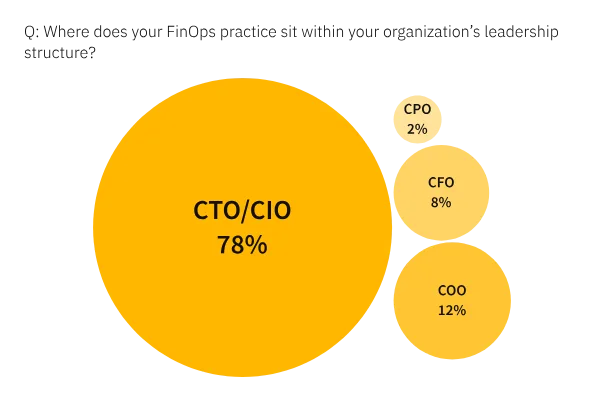
The official 2026 data verifies that FinOps has shifted left into engineering. A staggering 78% of FinOps practices now report directly to the CTO or CIO, while reporting to the CFO has plummeted to just 8%, proving that organizations are actively tying cloud spend directly to engineering performance.
These trends push legacy system modernization companies to adopt living roadmaps, continuously re-prioritizing work as new insights emerge.
Final Thoughts
Technical debt used to be tolerated as the cost of doing business. In 2026, it is viewed as an existential risk. Modernizing an estate is less about technology fashion and more about aligning architecture with continuous business change. The eight partners profiled represent a strategic cross-section of top legacy modernization companies.
No single vendor suits every context. The optimal path starts with a concise discovery, quantifies value, embeds security up front, and iterates without placing the business into a multi-year freeze.
With measurable checkpoints, transparent tooling, and a culture of incremental delivery, modernization becomes an engine for growth rather than a necessary evil.
FAQs
Why are companies investing in legacy modernization right now?
Security requirements, AI preparedness, and more general digital transformation objectives intersect. Modernizing organizations reduces expenses on maintenance and opens data to access new revenue streams. Infrastructure modernization drastically reduces technical debt, allowing digital initiatives and transformed data to directly drive between 21% and 50% of total enterprise value for the majority of modern organizations.
What are the main risks of continuing to rely on legacy systems?
Key risks include rising incident frequency, vendor end-of-life, regulatory non-compliance, and dwindling talent pools able to maintain vintage code.
What signs indicate that legacy systems in my organization require modernization?
The symptoms are increasing downtimes, release cycles of several months, failure to integrate new SaaS using APIs, and over-renewing licenses on old middleware.
What approaches are most effective for legacy system modernization?
Incremental strangler-fig patterns, event-stream decoupling, and automated code translation combined with targeted refactoring routinely deliver the best balance of speed and safety.
What tools and technologies are used to modernize legacy systems?
Popular stacks are Docker, Kubernetes, Terraform, Kafka, Pub/Sub, Istio, .NET 8, Spring Boot 3, code scanners powered by AI, and serverless runtimes on AWS, Azure, or GCP.
