


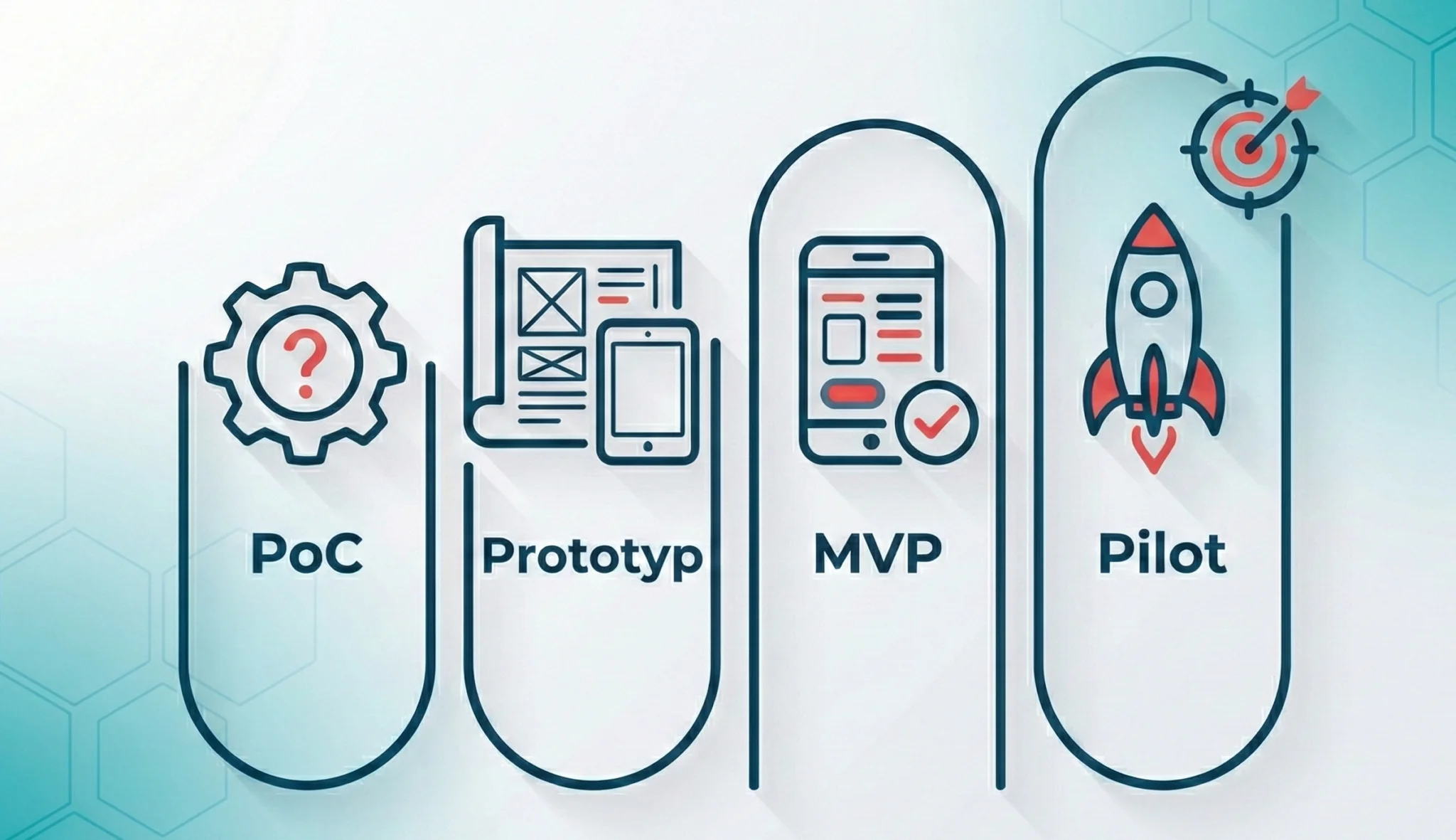
Someone on the team says, “let’s build a quick AI proof of concept.” Someone else calls it a pilot program. A third person is already sketching an MVP roadmap in Notion. These three terms get used like they’re interchangeable, but they aren’t.
Each one tests a different kind of risk. Mixing them up is one of the fastest ways to burn budget on an AI project that never lands anywhere solid.
This mix-up shows up constantly in AI work. AI models behave differently at every stage of testing. A model can nail a clean set of test questions in a spreadsheet. Then real customers show up with slang, typos, and oddly phrased requests, and the same model falls apart.
Knowing which stage you’re actually in saves real engineering time and budget, and it shows what that stage is actually built to prove. Many teams that provide AI consulting services map a new AI project against these three stages before writing any code.
Here’s a full breakdown: what each term means, what it costs, how long it typically runs, and how to tell which one your AI project needs right now.
Why the Confusion Happens?
Part of the confusion comes from vendors. Calling a project a “pilot” sounds more serious than a proof of concept. It also sounds less risky than a full launch. So some vendors label everything a pilot, regardless of scope. Part of the confusion comes from internal shortcuts too.
A team runs a two-day proof of concept. It looks promising. The label quietly upgrades to “MVP,” and nobody ever tests it on a real user.
Each stage answers a distinct question, and that’s the part worth locking in. A proof of concept checks whether the technology can work at all. A pilot checks whether it holds up with real people and real operational conditions.
An MVP checks whether people will actually use it, and ideally pay for it. Confuse the questions, and you measure the wrong thing at every stage. That’s how teams end up with a “successful” three-week POC. Six months later, it fails badly during a live rollout.
What a Proof of Concept Actually Proves?
A proof of concept, or POC, is the smallest test of technical feasibility. Picture a chef tasting a sauce before it reaches a table. Nobody eats a full meal yet. The point is only to confirm the core flavors work together.
For AI, a POC checks narrow technical claims. It might confirm a model can sort support tickets at an accuracy rate around 85 percent or higher. It might confirm a language model can summarize contracts without inventing clause numbers or dollar figures.
Or it might confirm a computer vision model catches product defects at a low enough error rate to matter on a factory line.
A POC typically runs on a small, curated dataset. Often that’s just a few hundred to a few thousand labeled examples. It measures precision, recall, and F1 score. It does not measure user satisfaction, because there are no real users yet.
A well-scoped AI POC generally looks like this:
- Timeline: one to four weeks
- Team: one to three engineers, no client-facing staff involved
- Data: a small, clean, curated sample, not live production data
- Cost: typically in the low five figures for most mid-size AI use cases
- Metric: a specific accuracy or performance threshold, set before testing starts, not “it seemed to work”
- Output: a go or no-go decision on technical feasibility, plus a list of what broke
A POC that hits its accuracy target is good news. It tells you the core idea isn’t fantasy. That’s all it tells you, though. It says nothing about whether staff will trust the tool. It says nothing about whether the model holds up on messy production data. And it says nothing about whether customers actually want it.
What a Pilot Is Actually Testing?
A pilot picks up exactly where the POC stops. The question shifts. It’s no longer “can this work.” It’s “does this hold up once real people and real operational mess get involved.” Picture a restaurant’s soft opening. A small group of paying diners. A kitchen under genuine pressure. Just not yet a full Saturday night crowd.
For AI, a pilot might mean routing an AI product recommendation engine to five or ten percent of a Shopify store’s traffic.
Or it might mean letting one support team run an AI ticket-triage tool for four to eight weeks, while a supervisor tracks its accuracy against human judgment. A pilot surfaces things a POC structurally cannot catch.
How the model handles messy, unpredictable input. Whether staff override its suggestions constantly, or actually trust them. And whether response time holds up once real, unfiltered traffic hits it, instead of a clean test file.
Pilots also expose the operational gaps that a tidy demo hides. A model might perform well in isolation. But if nobody built a retraining pipeline, accuracy can quietly drop as real-world data drifts away from the training set.
A compliance issue that never came up during the POC often surfaces for the first time here, like a data residency requirement.
A well-run pilot tracks concrete numbers: task completion rate, override or escalation rate, latency under real load, and a baseline comparison against the process it’s replacing.
What an MVP Is Really For?
An MVP, or minimum viable product, tests something different from either of the above: market demand. It’s not mainly a technical check. It’s not just an operations check either. It’s a direct test of whether people will choose to use the thing, and keep using it once the novelty wears off.
An MVP for an AI feature might be a stripped-down AI shopping assistant. Maybe it only handles size and fit questions at first. It goes out to a full customer base, not just a small sample group. It won’t be feature-complete, and that’s the point.
It’s real enough that customers form genuine opinions. Those opinions, not internal debate, decide what gets built next. Eric Ries described this build-measure-learn loop in “The Lean Startup,” and it still holds for AI products.
Customer reaction to AI features is hard to predict from internal testing alone. An AI MVP usually gets judged on retention after 30 days, conversion lift against a control group, and a direct complaint or cancellation rate. Model accuracy alone doesn’t tell you much at this stage.
Here’s a useful check: if the “MVP” hasn’t shipped to real, paying, or prospective customers, it’s still a pilot wearing an MVP’s label.
Side-by-Side Comparison
Here’s how the three stages stack up, side by side:
| Stage | Core question | Who’s involved | Typical timeline | Success metric |
|---|---|---|---|---|
| Proof of Concept | Can it work technically | Internal engineers only | 1 to 4 weeks | Accuracy, precision, recall against a set threshold |
| Pilot | Does it hold up in real conditions | A small group of real users or staff | 4 weeks to 3 months | Task completion, override rate, latency, staff trust |
| MVP | Will people use and value it | Full or broad customer base | Ongoing, first review at 60 to 90 days | Retention, conversion, adoption rate |
Technical risk gets addressed first. Operational risk comes next. Market risk comes last. Skipping a stage doesn’t remove that risk.
It just delays discovery. And that discovery usually lands at a point where it’s more expensive, and far more visible to customers.
Graduation Criteria: Knowing When to Move Forward
Most stalled AI projects fail here, not at the technical level. Set these criteria before you start, not after:
- POC to pilot: the model hits its accuracy threshold on test data it hasn’t seen before, and the team can name the specific ways it still fails.
- Pilot to MVP: the model matches or beats the process it’s replacing on at least two operational metrics, like speed, error rate, or cost per task. It holds that for four straight weeks, without heavy manual correction.
- MVP to full rollout: 30-day retention and conversion numbers hold steady or improve. That has to happen across a full customer group, not just the first eager early adopters.
Put a hard deadline on each stage. Ninety days is typical for a pilot. Put a go or no-go review on the calendar before the pilot even starts. Without that deadline, a pilot can run for a year with no clear finish line. It quietly eats budget while nobody wants to be the one to end it.
Only 25 percent of AI initiatives met their expected return last year, according to one compilation of enterprise AI spending data.
Where AI Projects Go Off the Rails?
The most common mistake isn’t picking the wrong stage. It’s treating success at one stage as proof for the next. IBM’s Watson Health division is a well-documented case. Early technical demonstrations looked strong. But the system struggled once it met the real complexity of hospital data and clinical workflows.
The division was eventually sold off in pieces. That’s a pilot-stage and market-stage failure. Early on, it got mistaken for a solved technical problem.
A second common misstep is skipping the pilot outright. A strong POC gets teams excited enough to jump straight to a full launch. Without a pilot, nobody learns how the model handles real data drift or edge cases. They find out on launch day instead, in front of actual customers.
A third misstep runs the other way. Call it pilot purgatory: a project stays in “small test group” mode for a year or more, because nobody ever defined what graduating would even look like. A 2025 MIT study found that roughly 95 percent of enterprise generative AI pilots never showed a measurable P&L impact.
Picking the Right Starting Point
Start with a proof of concept when the core uncertainty is technical. Maybe you’re not sure whether an AI tool can reliably pull data from a specific invoice format.
Tools like OpenAI’s API, Hugging Face’s model hub, and LangChain make it realistic to build a working prototype in days rather than months. The cost of finding out early is far lower than finding out in production.
Skip straight to a pilot when the technology’s capability is already proven. The open question here is operational: how it performs with real staff, real customers, and real data volume. Running a POC at that point mostly wastes time restating something already known.
Move to an MVP once the technical and operational questions are both settled. What’s left at that point is a market question: whether customers want the feature, and whether they’ll trust an AI system enough to rely on it. Ship it to real users. Track the behavior data instead of survey answers, and let that data shape the next version.
Summing It Up
A proof of concept, a pilot, and an MVP test three different kinds of risk, in a specific order: technical, then operational, then market.
Skipping a step doesn’t remove the risk behind it. It just defers the cost. That cost usually shows up later, at a point that’s more expensive and far more visible.
Set clear graduation criteria before starting any stage. Set a hard deadline too. That single habit does more than picking the “right” framework ever will. It’s what separates AI projects that ship from ones that quietly stall out in pilot mode for a year.
