


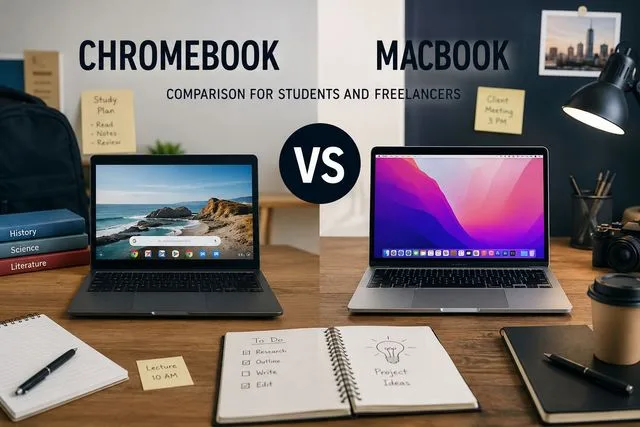
Students and freelancers often choose between two laptop categories that serve different working styles. One runs ChromeOS and focuses on browser-based tasks. The other runs macOS and supports a broader set of professional applications.
Both devices handle writing, communication, research, and media work, but they approach these tasks in different ways.
Some users encounter different online platforms during daily browsing. One example is a browser-based service that users may access in various regions, where an online platform such as honeybetz appears within general web activity honeybetz while users move between different digital tools and services.
In this context, it functions as just another website within a broader mix of online resources, without changing how the operating systems handle performance or workflows.
This comparison looks at real usage patterns rather than positioning. It focuses on speed in daily tasks, software access, mobility, cost structure, and long-term suitability for academic and freelance work.
How students use each system?
Students often switch between writing, research, video calls, and file sharing. They also need stable performance during long study sessions.
Chromebook users usually rely on:
- Web-based editors for essays and reports
- Cloud storage for assignments
- Browser tabs for research and note-taking
- Android apps for communication and study tools
MacBook users often rely on:
- Desktop writing tools for academic formatting
- Offline apps for editing and presentations
- Research tools with advanced features
- Creative tools for media projects
Chromebooks handle lightweight tasks with fast response times and simple setup. MacBooks handle complex assignments that require heavier software.
Students who work mostly online tend to stay within ChromeOS workflows. Students who study design, coding, or media production often use macOS tools more frequently.
Freelancers and work requirements
Freelancers shape their workflow around deadlines, clients, and file compatibility.
Chromebooks support freelancers who:
- Write articles and manage content systems
- Work inside browser-based platforms
- Use communication tools like video conferencing apps
- Store files in cloud services
MacBooks support freelancers who:
- Edit video or audio content
- Work with design software
- Manage multiple professional applications at once
- Run local development environments
Freelancers often choose based on software demands rather than device type. A writer or social media manager can complete tasks inside a browser setup. A video editor or developer usually depends on desktop-level software support.
Performance in daily tasks
Both devices handle standard tasks like browsing, email, and document editing without issues. Differences appear when workloads increase.
Chromebook performance characteristics:
- Fast startup times
- Low system overhead
- Smooth performance with browser-based apps
- Limited local processing for heavy tasks
MacBook performance characteristics:
- Strong handling of large files
- Stable multitasking with multiple apps
- Higher processing power for editing and coding
- Consistent performance under load
Chromebooks maintain steady speed when users stay online. MacBooks maintain performance even when users run demanding offline applications.
Software access and ecosystem
Software availability often decides which device fits a user better.
Chromebook software access:
- Web applications
- Android apps
- Linux-based tools on supported models
- Cloud services for most tasks
MacBook software access:
- Desktop applications for professional work
- Creative suites for design and editing
- Development tools for programming
- Offline and online hybrid workflows
Students who rely on browser tools rarely face limitations on Chromebooks. Freelancers who depend on specialized software often find macOS more suitable.
Portability and battery behavior
Mobility plays a key role for students moving between classes and freelancers working from different locations.
Chromebook characteristics:
- Lightweight hardware design
- Long battery life in many models
- Fast wake and resume functions
- Low power consumption
MacBook characteristics:
- Solid build with balanced weight
- Strong battery life under mixed workloads
- Efficient performance management
- Stable performance during travel use
Both devices support mobile work, but Chromebooks usually prioritize simplicity and low energy use, while MacBooks balance performance with portability.
Cost considerations
Budget often becomes the first filter in device selection.
Chromebooks generally:
- Start at lower price points
- Target basic to mid-level tasks
- Require fewer hardware upgrades
- Depend more on cloud storage solutions
MacBooks generally:
- Sit in a higher price range
- Offer stronger hardware for long-term use
- Reduce need for frequent replacement
- Include higher resale value over time
Students with limited budgets often choose Chromebooks for basic study needs. Freelancers with higher income expectations often invest in MacBooks for long-term performance stability.
Storage and file handling
Storage behavior also differs between systems.
Chromebook storage model:
- Focus on cloud storage
- Limited local space
- Fast synchronization with online accounts
- Simple file structure
MacBook storage model:
- Large internal storage options
- Full offline file management
- Local backup and external drive support
- Flexible file organization
Users who work in stable internet environments often prefer Chromebooks. Users who work with large media files or offline projects often rely on MacBooks.
Security and maintenance
Both systems handle security differently.
Chromebook security approach:
- Automatic updates in the background
- Limited exposure to traditional software threats
- Sandboxed applications
- Minimal user maintenance
MacBook security approach:
- Regular system updates
- Built-in security tools for file protection
- Broader control over installed software
- User-managed system maintenance in some cases
Chromebooks reduce maintenance steps. MacBooks give users more control over system behavior.
Use case table
| Category | Chromebook | MacBook |
| Web browsing | Strong performance | Strong performance |
| Writing tasks | Smooth and fast | Smooth and advanced |
| Video editing | Limited support | Strong support |
| Programming | Basic to moderate | Advanced support |
| Battery life | Often longer in light use | Stable across workloads |
| Software access | Web and Android apps | Full desktop applications |
| Storage | Cloud-based focus | Local and cloud hybrid |
Learning curve and usability
Students often prefer simplicity when starting new workflows.
Chromebook usability:
- Simple interface with fewer settings
- Quick setup process
- Direct integration with web tools
- Limited system complexity
MacBook usability:
- More configuration options
- Broader control over system settings
- Larger software ecosystem
- Steeper learning curve for beginners
Users who value minimal setup time often stay with Chromebooks. Users who want more control over workflows often adapt to MacBooks.
Real-world workflow examples
A student writing essays, attending online classes, and managing notes can complete all tasks on a Chromebook without switching environments.
A freelance video editor working with large media files, client revisions, and export workflows can complete tasks more efficiently on a MacBook.
A freelance writer who uses browser-based CMS tools can work effectively on either device, depending on personal preference and budget.
A programming student can start with a Chromebook for basic coding tasks and later move to a MacBook for advanced development environments.
Final comparison insights
Chromebooks and MacBooks serve different working patterns rather than competing directly in every area.
Chromebooks focus on:
- Browser-first workflows
- Low maintenance use
- Budget-friendly access
- Fast cloud integration
MacBooks focus on:
- Professional software support
- Strong offline performance
- Creative and technical workflows
- Long-term hardware stability
Students and freelancers often choose based on workload type, software needs, and budget range. Each system fits specific working habits without replacing the other.
