


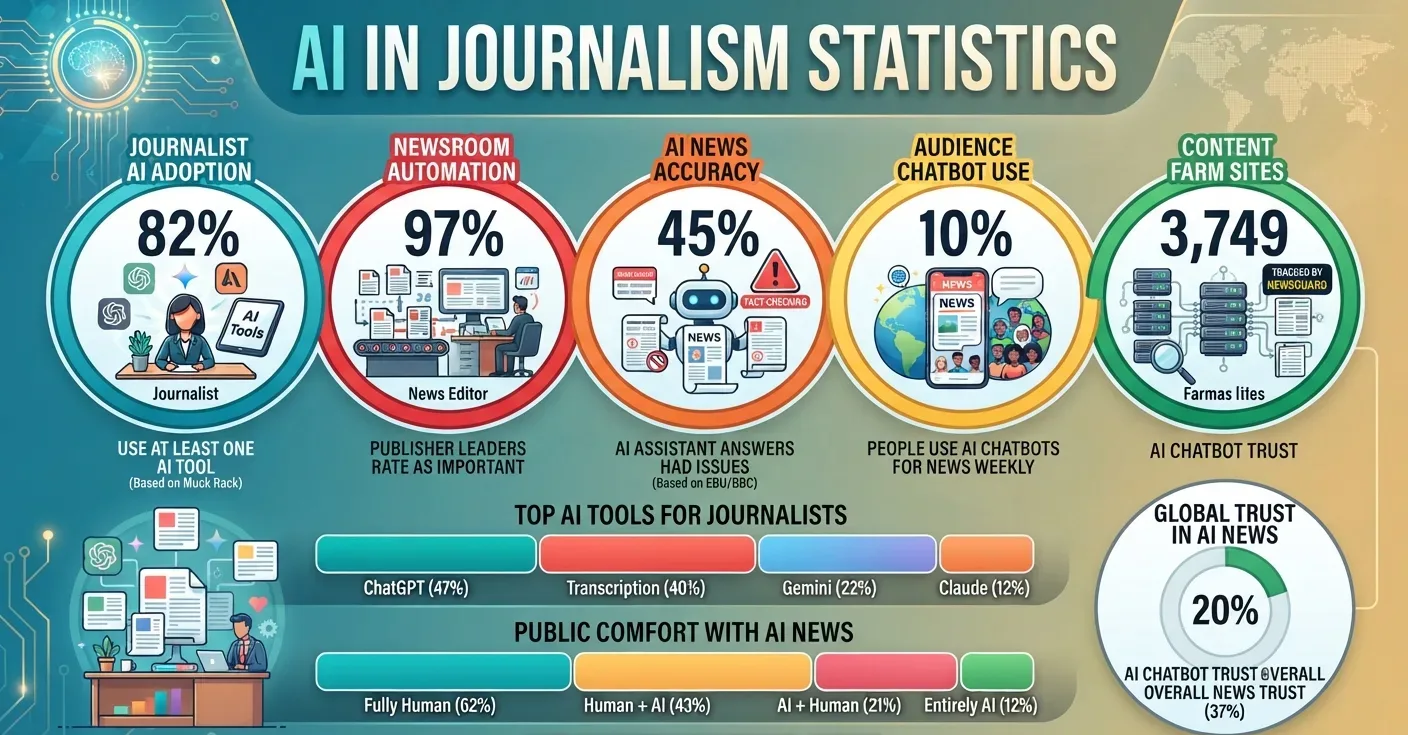
82% of journalists use at least one AI tool, per Muck Rack’s State of Journalism 2026. On the audience side, 10% of people across 48 markets use AI chatbots for news each week, according to the Reuters Institute’s Digital News Report 2026. The AI in journalism statistics below cover adoption, newsroom use cases, accuracy, audience trust, publisher traffic and AI content farms, using reports from March 2025 to June 2026.
AI in Journalism Statistics
How Many Journalists Use AI in 2026?
82% of journalists report using at least one AI tool, up from 77% a year earlier. Muck Rack based its State of Journalism 2026 findings on 897 responses collected between January 30 and March 2, 2026, mostly from US-based journalists.
Gemini use rose from 13% to 22% over the year. Claude doubled from 6% to 12%, and its wider footprint appears in these Claude usage trends.
| AI tool | Share of journalists using it (2026) |
|---|---|
| At least one AI tool | 82% |
| ChatGPT | 47% |
| Transcription tools | 40% |
| Gemini | 22% |
| Claude | 12% |
Source: Muck Rack, State of Journalism 2026 (January to March 2026; multiple answers allowed)
ChatGPT is the most-used tool among surveyed journalists at 47%. Its reach beyond newsrooms is covered in this set of ChatGPT user figures.
Concern is climbing too. 26% of journalists now cite unchecked AI as a top threat to the profession, up from 18%, while disinformation and lack of funding tie at 32%.
Source: Muck Rack, State of Journalism 2026 (January to March 2026)
AI in Journalism Statistics by Newsroom Use Case
Back-end automation is rated important by 97% of publisher respondents in the Reuters Institute’s Trends and Predictions 2026 survey. Newsgathering follows at 82%, with coding and product development at 81%.
The survey covered 280 digital leaders from 51 countries between November 18 and December 20, 2025. It is a strategic sample of senior executives, not a representative one.
On the stricter “very important” measure, back-end tasks such as transcription and automated metadata lead at 64%. Coding and product development reached 44%, up 16 points in a year.
Source: Reuters Institute, Journalism, Media and Technology Trends and Predictions 2026 (survey November to December 2025)
Are Newsroom AI Projects Paying Off?
13% of leaders call their newsroom AI initiatives transformational. Another 44% describe results as promising, and 42% as limited.
Reuters’ FactGenie tool, used by 150 journalists, has halved the average time to send non-corporate alerts. UK regional publisher Newsquest has more than 30 AI-assisted reporters who draft stories that staff then check.
Source: Reuters Institute, Trends and Predictions 2026 (January 2026)
Has AI Cut Newsroom Jobs?
| Effect of AI on staffing | Share of leaders |
|---|---|
| No reduction in roles | 67% |
| Small number of staff or freelance cuts | 16% |
| Roles or costs added | 9% |
Source: Reuters Institute, Trends and Predictions 2026 (survey November to December 2025)
45% of AI Assistant News Answers Had a Significant Issue
Journalists from 22 public service broadcasters in 18 countries reviewed more than 3,000 answers from ChatGPT, Copilot, Gemini and Perplexity in 14 languages. The EBU and BBC study, published October 22, 2025, found 45% contained at least one significant issue.
Sourcing caused the most failures, with serious problems in 31% of responses. Major accuracy issues, including hallucinated details and outdated information, appeared in 20%.
Gemini recorded significant sourcing issues in 72% of its responses and significant issues of any kind in 76%. ChatGPT sat at 24% on sourcing, with Copilot and Perplexity at 15% each.
Source: EBU and BBC, News Integrity in AI Assistants (October 2025)
How Often Do AI Search Engines Cite News Correctly?
The Tow Center at Columbia Journalism Review ran 1,600 queries through eight AI search engines in March 2025. The tools answered more than 60% incorrectly, from 37% for Perplexity to 94% for Grok 3.
ChatGPT misidentified 134 of its 200 test articles yet signalled uncertainty in 15 responses.
Source: Tow Center for Digital Journalism, AI Search Has a Citation Problem (March 2025)
How Many People Get News From AI Chatbots?
10% of people use standalone AI chatbots for news each week, up from 7% in 2025, according to the Digital News Report 2026. Just 1% name AI as their main news source.
The Reuters Institute surveyed 97,520 people online across 48 markets for the report, published June 16, 2026. Chatbots in scope include ChatGPT, Perplexity and Google Gemini.
| Market | Weekly AI chatbot use for news (2026) |
|---|---|
| Average of 48 markets | 10% |
| South Korea | 14% |
| Greece | 12% |
| United Kingdom | 4% |
Source: Reuters Institute, Digital News Report 2026 (published June 16, 2026)
South Korea, Greece and Spain doubled their usage year on year. The US, UK, France and Germany recorded no increase, and the UK is the lowest of all 48 markets at 4%.
Age shapes use. 17% of the youngest group use chatbots for news weekly, against 5% of the oldest.
What Do People Use AI Chatbots For in News?
Asking follow-up questions leads at 42% of chatbot news users across 45 markets. Getting the latest news (35%), summaries (34%), checking source reliability (33%) and simplifying stories (30%) follow, and respondents could pick several uses.
Source: Reuters Institute, Digital News Report 2026 (45 markets)
Do Chatbot Users Trust and Click Through?
Trust in news from AI chatbots stands at 20% globally, against 37% for news overall. Among chatbot users it reaches 44%, compared with 17% of non-users.
42% of chatbot news users say they always or often click through to original sources, from 56% in South Korea to 26% in Denmark. Measured across all respondents in 27 markets, the figure is 4% for chatbots, 19% for search and 17% for social media.
Source: Reuters Institute, Digital News Report 2026 (published June 16, 2026)
12% Comfort Rate: AI in Journalism Statistics on Public Trust
12% of people in six countries are comfortable with news made entirely by AI. That figure rises to 21% with human oversight, 43% when a human leads with AI help, and 62% for fully human news.
| How the news is made | Share comfortable (2025) |
|---|---|
| Entirely by AI | 12% |
| Mostly AI, with human oversight | 21% |
| Mostly human, with some AI help | 43% |
| Entirely by a human journalist | 62% |
Source: Reuters Institute, Generative AI and News Report 2025 (YouGov online panels of about 2,000 per country in six countries, June to July 2025; each scenario asked separately)
Back-end tasks draw the most acceptance: 55% are comfortable with AI editing spelling and grammar, and 53% with translation. Artificial presenters or authors sit lowest at 19%.
Oversight doubts persist. 33% think journalists always or often check AI outputs before publishing, from 25% in the UK to 44% in Argentina.
AI labels reach 19% of respondents daily, while 77% use news daily.
Source: Reuters Institute, Generative AI and News Report 2025 (June to July 2025)
Publisher Traffic and Licensing: AI in Journalism Statistics
Google organic search traffic to more than 2,500 news sites fell 33% globally between November 2024 and November 2025, and 38% in the US, based on Chartbeat data in the Reuters Institute’s 2026 trends report. The report says the share caused by AI Overviews is unclear.
Publishers expect search referrals to fall a further 43% over the next three years. Google’s AI Mode tab is available in 120 markets, per the same report.
ChatGPT referrals are rising from a small base. Google still sends 500 times as many referrals from search alone, or 1,300 times as many including Discover.
| Expected income from AI licensing deals | Share of publisher respondents |
|---|---|
| Substantial | 20% |
| Minor contribution | 49% |
| None | 20% |
Source: Reuters Institute, Trends and Predictions 2026 (survey November to December 2025)
Three-quarters (75%) of leaders expect agentic AI tools to have a large or very large impact on the industry. Confidence in journalism’s prospects stands at 38%, 22 points below the 2022 survey.
Source: Reuters Institute, Trends and Predictions 2026 (survey November to December 2025)
NewsGuard Tracks 3,749 AI Content Farm Sites
NewsGuard had identified 3,749 AI content farm news and information sites across 16 languages as of June 23, 2026. Its March 12, 2026 count stood at 3,006, a total NewsGuard said had more than doubled over the prior year.
| Date | AI content farm sites identified |
|---|---|
| March 12, 2026 | 3,006 |
| June 23, 2026 | 3,749 |
Source: NewsGuard press release (March 12, 2026) and AI Tracking Center (updated June 23, 2026)
In March, NewsGuard put the pace at 300 to 500 new sites a month. Pangram Labs software flags candidate domains, and NewsGuard analysts review each one before labelling it.
Detection tools vary in performance, as these AI content detector accuracy tests show. Fewer than 1% of news images or videos published worldwide carry C2PA provenance metadata.
Source: Reuters Institute, Trends and Predictions 2026 (January 2026)
FAQs
What percentage of journalists use AI?
82% of journalists used at least one AI tool in Muck Rack’s State of Journalism 2026 survey, up from 77% in 2025. ChatGPT was the most-used tool, at 47% of respondents.
How accurate are AI assistants at reporting news?
Accuracy remains weak. The EBU and BBC study from October 2025 found 45% of news answers from ChatGPT, Copilot, Gemini and Perplexity had at least one significant issue, and 31% had serious sourcing problems.
Do people trust AI-generated news?
Few do. The Digital News Report 2026 puts trust in news from AI chatbots at 20% globally, against 37% for news overall. Just 12% in six countries are comfortable with news made entirely by AI.
Is AI replacing journalists, as many Reddit threads suggest?
Not at scale so far. In the Reuters Institute’s 2026 survey of 280 news leaders, 67% reported no AI-related role reductions, 16% reported small cuts and 9% added roles or costs.
How many people get news from AI chatbots?
10% of people across 48 markets used AI chatbots for news weekly in 2026, up from 7% in 2025. Use reaches 17% in the youngest age group and 5% in the oldest.
References
https://muckrack.com/resources/research/state-of-journalism
https://reutersinstitute.politics.ox.ac.uk/digital-news-report/2026/dnr-executive-summary
