


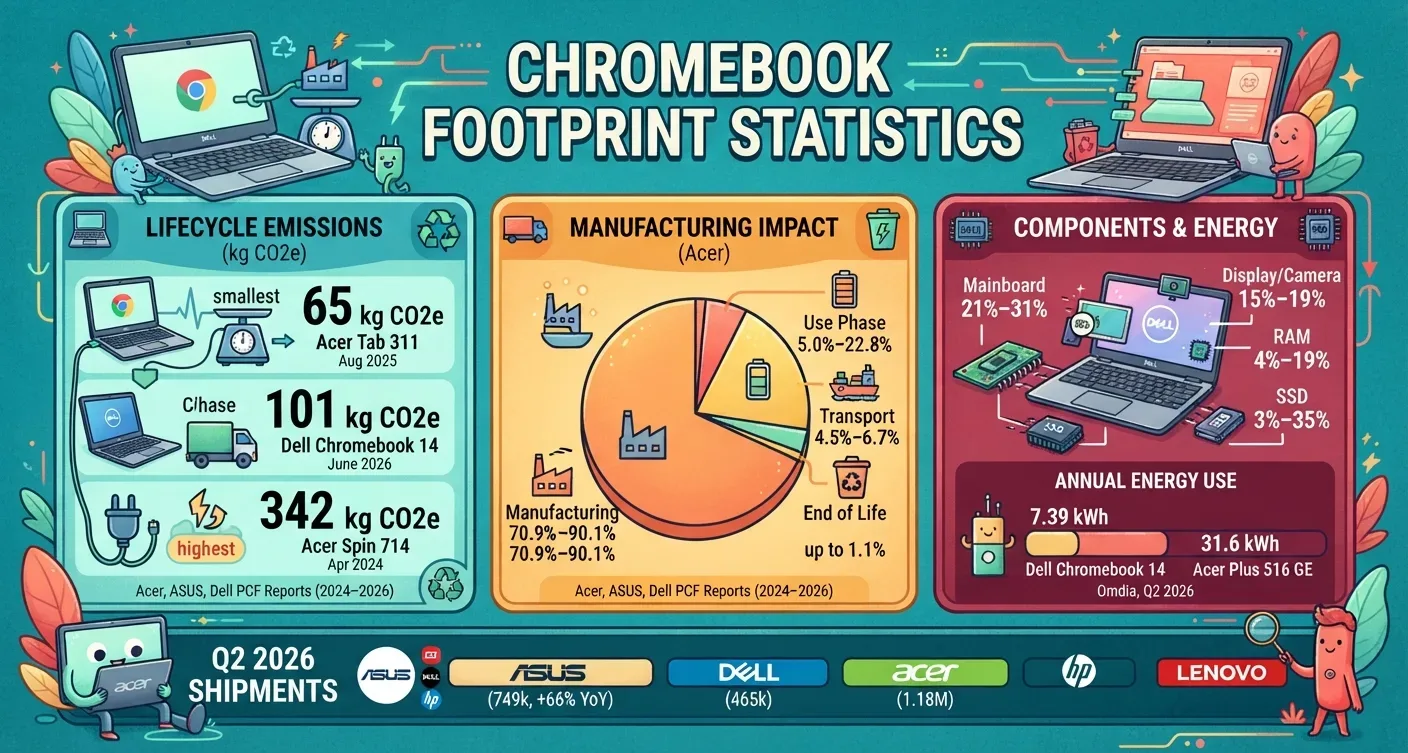
Dell’s Chromebook 14 CC14260 is rated at 101 kg CO2e in a June 2026 report. Acer’s Chromebook 315 CB315-8H comes in at 227 kg in a March 2026 report. Both figures cover four years of use but come from different calculation methods. This page sets out the Chromebook carbon footprint data Acer, ASUS and Dell publish per model, covering lifecycle totals, phase splits, component shares and annual energy use, plus Q2 2026 shipments for those brands.
Chromebook Carbon Footprint Statistics
How Much CO2e Does a Chromebook Emit Over Its Rated Life?
Acer’s seven Chromebook reports reviewed here run from 65 kg CO2e on the Chromebook Tab 311 to 342 kg on the Chromebook Spin 714. Each figure is a mean over a four-year life, with use modeled in Europe.
The newest report, dated March 2026, puts the Chromebook 315 CB315-8H at 227 ± 54 kg. February 2026 brought the Chromebook 311 C725 in at 183 ± 36 kg.
| Acer model | Report date | Mean kg CO2e | Std. deviation | 5th–95th percentile | PAIA tool |
|---|---|---|---|---|---|
| Chromebook 315 CB315-8H | Mar 2026 | 227 | ± 54 | 130–503 | Notebook 1.5.3 |
| Chromebook 311 C725 | Feb 2026 | 183 | ± 36 | 107–358 | Notebook 1.5.3 |
| Chromebook Plus Spin 514 CP514-5HN | Aug 2025 | 209 | ± 45 | 116–454 | Notebook 1.4.7 |
| Chromebook Tab 311 D723N | Aug 2025 | 65 | ± 30 | 24–243 | Tablet 1.4.7 |
| Chromebook 514 C937 | Apr 2025 | 245 | ± 52 | 144–493 | Notebook 1.4.7 |
| Chromebook Spin 714 CP714-2W | Apr 2024 | 342 | ± 80 | 205–659 | Notebook 1.3.2 |
| Chromebook Plus 516 GE CBG516-2H | Mar 2024 | 332 | ± 80 | 177–691 | Notebook 1.4.0 |
Source: Acer Product Carbon Footprint reports, March 2024 to March 2026
The uncertainty bands are wide. The Chromebook 311 C725 spans 107 to 358 kg, which overlaps the Chromebook 514 C937’s band of 144 to 493 kg.
Acer states in each report that PAIA results are not recommended for use in comparisons.
Chromebook Carbon Footprint by Lifecycle Phase
Manufacturing ranges from 70.9% of the total on the Chromebook Tab 311 to 90.1% on the Chromebook Spin 714. End of life never exceeds 1.1%, and transport stays between 4.5% and 6.7%.
The Tab 311 carries the highest use share at 22.8%. Among the notebooks, the Plus 516 GE is highest at 18.8%.
| Acer model | Manufacturing | Use | Transport | End of life |
|---|---|---|---|---|
| Chromebook Spin 714 (Apr 2024) | 90.1% | 5.0% | 4.5% | 0.4% |
| Chromebook 514 C937 (Apr 2025) | 85.3% | 8.0% | 6.1% | 0.6% |
| Chromebook 311 C725 (Feb 2026) | 83.2% | 10.3% | 6.0% | 0.5% |
| Chromebook 315 CB315-8H (Mar 2026) | 82.8% | 10.1% | 6.5% | 0.6% |
| Chromebook Plus Spin 514 (Aug 2025) | 78.7% | 14.0% | 6.7% | 0.6% |
| Chromebook Plus 516 GE (Mar 2024) | 75.4% | 18.8% | 5.3% | 0.5% |
| Chromebook Tab 311 (Aug 2025) | 70.9% | 22.8% | 5.2% | 1.1% |
Source: Acer Product Carbon Footprint reports, March 2024 to March 2026
What Do ASUS and Dell Report Under Different Methods?
Dell’s April 2026 PCF FAQ says cross-brand comparisons are uncertain because each brand uses different data and assumptions. Acer uses PAIA, while Dell uses its own ISO 14040 certified calculator.
ASUS Chromebook Reports, June 2025
Three ASUS Chromebook reports dated June 2025 list totals between 138 and 155 kg CO2e. All three assume four years of use, assembly in China and worldwide use.
| ASUS model | Report date | kg CO2e | Yearly energy, kWh |
|---|---|---|---|
| Chromebook CX14 CX1405CKA | Jun 2025 | 155 | 10.94 |
| Chromebook CR11 Flip CR1104FTA | Jun 2025 | 146 | 12.14 |
| Chromebook CR12 CR1204CTA | Jun 2025 | 138 | 10.32 |
Source: ASUS Product Carbon Footprint Reports, June 2025
Dell Chromebook Reports, 2025–2026
Dell publishes a single figure for each model, excluding end-of-life credits, with use modeled in Europe over four years. The Chromebook 14 moved to Calculator Version 2 in June 2026.
| Dell model | Report date | PCF Calculator | kg CO2e | Yearly energy, kWh |
|---|---|---|---|---|
| Chromebook 14 CC14260 | Jun 2026 | Version 2 | 101 | 7.39 |
| Chromebook 11 CC11260 | Sep 2025 | Version 1 | 73.9 | 8.3 |
| Dell 15 DC15250 laptop | Sep 2025 | Version 1 | 160 | 14.7 |
Source: Dell Technologies Product Carbon Footprint reports, September 2025 and June 2026
The cleanest pairing in this set uses the same calculator version and the same report month. It puts the Chromebook 11 at 73.9 kg and the Dell 15 laptop at 160 kg.
Dell’s FAQ says comparisons between one manufacturer’s models can be explored when a standardized method is used.
Embodied Carbon Breakdown in Three Dell PCF Reports
Dell splits manufacturing emissions by component, which shows where embodied carbon sits inside each device.
RAM accounts for 19% of manufacturing emissions on the Chromebook 14 CC14260, against 10% on the Chromebook 11 CC11260. Both use 8 GB of memory.
The Version 2 report also lists the CPU separately at 19%. For that reason, its 21% mainboard share is not directly comparable with the Version 1 reports, which list no separate CPU line.
Storage drives the Dell 15’s footprint. Its 512 GB SSD takes 35% of manufacturing emissions, against 16% for the Chromebook 11’s 256 GB SSD.
| Component | Chromebook 11 CC11260 | Chromebook 14 CC14260 | Dell 15 DC15250 |
|---|---|---|---|
| Mainboard | 30% | 21% | 31% |
| CPU | Not listed | 19% | Not listed |
| SSD | 16% | 3% | 35% |
| RAM | 10% | 19% | 4% |
| Display (incl. camera) | 19% | 19% | 15% |
| Battery | 7% | 5% | 4% |
| Mechanicals | 9% | 8% | 7% |
| Power supply unit | 7% | 5% | 3% |
| Thermal solution | 0% | 0% | 1% |
| Other | 1% | 1% | 2% |
| Packaging | 1% | 0% | 0% |
Source: Dell Technologies Product Carbon Footprint reports, September 2025 and June 2026
Dell’s FAQ notes that choosing a bigger SSD or more memory raises embodied emissions. Spec trends across current models sit in these Chromebook hardware figures.
Annual Energy Use Behind the Chromebook Carbon Footprint
Acer’s yearly typical energy consumption figures run from 7.56 kWh on the Chromebook Tab 311 to 31.6 kWh on the Chromebook Plus 516 GE. The Chromebook Spin 714 lists 8.7 kWh.
Source: Acer Product Carbon Footprint reports, March 2024 to March 2026
Dell lists 7.39 kWh a year for the Chromebook 14 and 8.3 kWh for the Chromebook 11, against 14.7 kWh for the Dell 15 laptop.
Source: Dell Technologies Product Carbon Footprint reports, September 2025 and June 2026
The ASUS figures fall between 10.32 and 12.14 kWh across its three June 2025 Chromebook reports. Platform-level wattage gaps are covered in this ChromeOS and Windows power draw comparison.
Source: ASUS Product Carbon Footprint Reports, June 2025
Does Google’s 10-Year Update Policy Show Up in Chromebook Carbon Footprint Reports?
No. All 12 Chromebook reports reviewed here state a four-year product lifetime: seven from Acer, three from ASUS and two from Dell.
Google announced in September 2023 that Chromebooks released from 2021 onward would get 10 years of automatic updates, starting in 2024. Owners of older models can opt into an extension to 10 years from the platform’s release.
Source: Google, Chromebook automatic update announcement, September 2023
Acer’s February and March 2026 reports still list four years. None of the reports reviewed models a longer service life, even though real-world use often runs past that, as these Chromebook lifespan figures show.
Platform release year still sets each device’s cutoff date. Model-by-model timing appears in these auto update expiration statistics.
Q2 2026 Shipments From Brands Publishing Footprint Reports
| Vendor | Q2 2026 Chromebook shipments | Year-on-year change |
|---|---|---|
| Lenovo | 1.76 million | −3% |
| Acer | 1.18 million | −4% |
| HP | 1.15 million | −13% |
| Asus | 749k | +66% |
| Dell | 465K | −47% |
Source: Omdia, Q2 2026 (released August 6, 2026)
Acer, Asus and Dell, the three brands whose reports appear above, shipped 1.18 million, 749k and 465K Chromebooks in the quarter. Asus more than doubled its market share, from 8% to 16%.
Omdia says memory now takes an outsized share of the bill of materials for budget and education-tier devices. Pricing pressure on those models is tracked in these Chromebook selling price figures.
Omdia links the category’s decline to low profitability, a high Q2 2025 base and delayed deployments. Business-side volumes are broken out in this enterprise deployment data.
FAQs
What is the carbon footprint of a Chromebook?
The reports reviewed here range from 65 kg CO2e for the Acer Chromebook Tab 311 (August 2025) to 342 kg for the Acer Chromebook Spin 714 (April 2024). Each covers a four-year life, and methods vary by brand.
How much electricity does a Chromebook use per year?
Manufacturer reports list 7.39 kWh for the Dell Chromebook 14 CC14260 (June 2026) up to 31.6 kWh for the Acer Chromebook Plus 516 GE (March 2024).
Is manufacturing or use the bigger source of Chromebook emissions?
Manufacturing. Acer’s seven reports put it at 70.9% to 90.1% of the total, with the use phase between 5.0% and 22.8%.
Do Chromebook carbon reports account for 10 years of updates?
No. All 12 Acer, ASUS and Dell Chromebook reports reviewed assume a four-year life. Google gives Chromebooks released from 2021 onward 10 years of automatic updates.
Are Reddit claims that Chromebooks are greener backed by data?
Reddit threads share opinions, not lifecycle data. Dell’s own reports rate its Chromebook 11 at 73.9 kg CO2e against 160 kg for its Dell 15 laptop, both from September 2025.
Sources
https://www.acer.com/ee-en/sustainability/product-carbon-footprint
https://esg.asus.com/files/carbon_footprint/Product-Carbon-Footprint-Report_CX1405CKA.pdf
https://www.dell.com/en-us/lp/dt/product-carbon-footprints
https://commandlinux.com/statistics/chromebook-shipments-by-manufacturer
https://commandlinux.com/statistics/chromebook-average-selling-price-trends
