


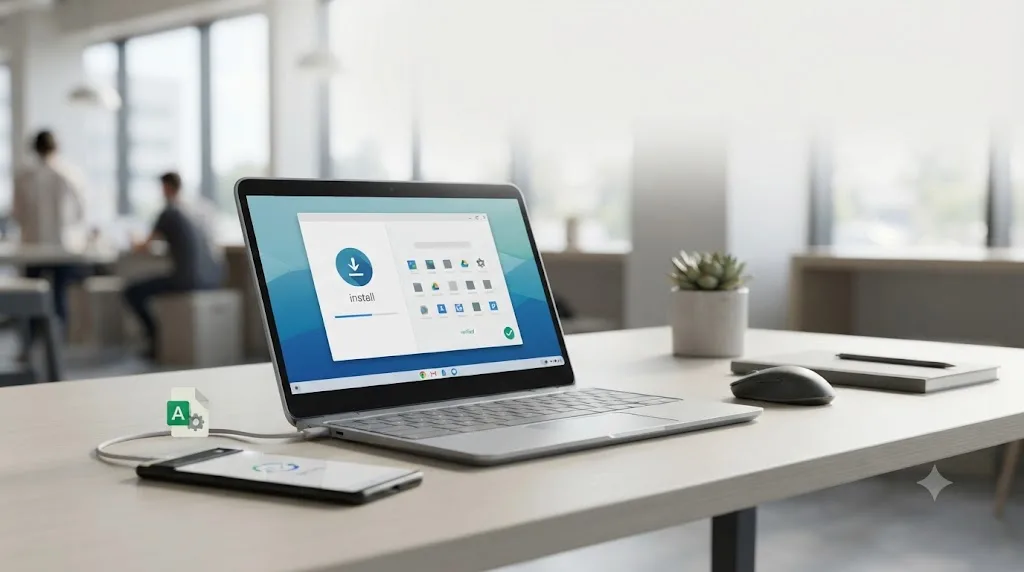
Chromebooks have always occupied an interesting middle ground in computing—lightweight, security-focused, and increasingly capable.
When Google introduced the ability to run Android apps natively on ChromeOS through the ArcVM virtualization layer, it fundamentally expanded what these devices could do.
Yet many Chromebook users remain unaware of the full possibilities, particularly when it comes to accessing applications outside the Google Play Store through APK files.
Understanding how to safely sideload Android apps, whether it’s productivity tools, media applications, or niche software like تحميل 1xbet اخر إصدار, opens an entire ecosystem that bridges the gap between the ChromeOS and Android environments in ways that formal app store listings sometimes don’t support.
How ChromeOS Handles Android Apps
The technical foundation here is important to understand. ChromeOS doesn’t run Android apps the way a traditional Android phone does. Instead, Google implemented ArcVM (Android Runtime for Chrome), a virtualized container that runs Android within the ChromeOS environment.
This architectural choice matters because it means Android apps on Chromebooks operate with certain constraints and capabilities that differ from their phone counterparts.
Not every Chromebook supports Android apps. The feature rolled out gradually, starting with select models, and availability depends on your device’s processor generation and architecture.
Most recent Chromebooks with modern Intel or ARM processors support it, but older devices may not. Checking your specific model’s compatibility is the essential first step before attempting anything else.
Once Android app support is available on your device, Google Play integration becomes automatic. You get access to millions of apps through the official store, just like on a phone. However, the Play Store represents a curated, centralized distribution method.
Some developers choose not to list apps there, or they may offer versions outside the store with additional features or configurations. This is where APK sideloading enters the picture.
An APK file is simply the installation package for an Android app—the raw application file before it’s wrapped in store distribution channels.
Sideloading means installing that application directly onto your Chromebook without going through the Play Store. This is entirely legitimate, but it requires caution and understanding of the risks involved.
ChromeOS’s security model is built on sandboxing and isolation. Each app operates in its own container with limited access to system resources. When you sideload an APK, that same sandboxing still applies, which is reassuring.
However, sideloading bypasses Google’s app review process, which means you’re assuming greater responsibility for verifying that the application comes from a trustworthy source.
Installing APKs Safely Outside the Play Store
The technical process of sideloading is straightforward, but the security practices that must accompany it are non-negotiable.
First, developer mode must be enabled on your Chromebook. This varies slightly by model, but generally involves powering off the device, holding specific key combinations, and confirming that you understand you’re entering a mode with reduced security protections. Don’t skip this step lightly—you’re explicitly choosing to lower your device’s security posture.
Once developer mode is active, you can transfer APK files to your Chromebook using a USB drive or by downloading them directly. This is where the critical security decision occurs: verifying the source. Where did this APK come from?
Is it from the developer’s official website? Was it obtained through a trustworthy third-party aggregator? Or did you download it from a random forum? The integrity of your entire device depends on this decision.
Examine the app permissions carefully before installation. Android requires apps to request permissions for sensitive functions—camera access, microphone, storage, location, contacts, and so forth.
An app that requests permissions wildly beyond what it should need for its stated function is a red flag. A weather app that requests location? Reasonable. A weather app that requests access to your contacts list? Suspicious.
Keep your ChromeOS system completely updated. Security patches and kernel updates are your primary defense against malicious software. A device running outdated software is exponentially more vulnerable to exploitation than a current system.
Performance and compatibility represent the other side of sideloading. Not every Android app runs perfectly on ChromeOS.
Some rely on phone-specific hardware like cellular radios. Others may assume specific screen sizes or input methods. Testing reveals compatibility issues quickly.
Security considerations when sideloading Android apps:
- Enable developer mode only when necessary — it’s a deliberate reduction in security posture
- Verify the APK source rigorously — official developer websites or established trusted sources only
- Review requested permissions thoroughly — flag apps asking for access beyond their stated function
- Scan the file before installation — use antivirus scanning tools if available
- Keep ChromeOS aggressively updated — security patches close vulnerabilities faster than any other protection
- Note performance and compatibility limits — ChromeOS isn’t Android; not everything runs identically
When Sideloading Makes Sense?
Sideloading isn’t something every user needs to do. For most people, the Google Play Store offers everything they require. But legitimate use cases exist.
Developers often distribute beta or testing versions of applications outside the Play Store. Users invested in that development process might want access to newer features before official release. This supports active participation in app development communities.
Some applications are region-restricted on the Play Store due to legal or regulatory requirements. A user legitimately entitled to use an app in their jurisdiction might need to sideload to access it if their region isn’t officially supported in the store.
Organizations sometimes deploy internal or custom applications through APK distribution for employees or specific user groups. This is how enterprise software often reaches dedicated users without public app store listings.
There’s also the legitimate appeal of having direct control over which version of an application you run. Some users prefer older versions they trust, or they want to run versions without certain integrations they find objectionable.
Responsible Use and Moving Forward
Sideloading APK files is a legitimate capability built into Android and ChromeOS, but it’s a capability that demands maturity from the user.
The security responsibility shifts entirely to you once you’ve bypassed the Play Store review process. This isn’t something to approach casually.
Going forward, expect ChromeOS’s Android integration to deepen. Google continues expanding the capabilities of ArcVM and improving the experience of running Android applications on Chromebooks. The distinction between ChromeOS and Android may blur further.
For now, understanding the technical reality and the responsibility it entails allows you to make informed decisions about which apps to install and how to install them safely.
Conclusion
Chromebooks have evolved from simple web-browsing devices into genuine hybrid systems that seamlessly blend ChromeOS and Android capabilities.
The ability to sideload APK files extends that capability even further, but it comes with the requirement to be thoughtful, cautious, and deliberate in how you exercise that capability. The process is technically simple; the wisdom lies in understanding when and how to use it responsibly.
