


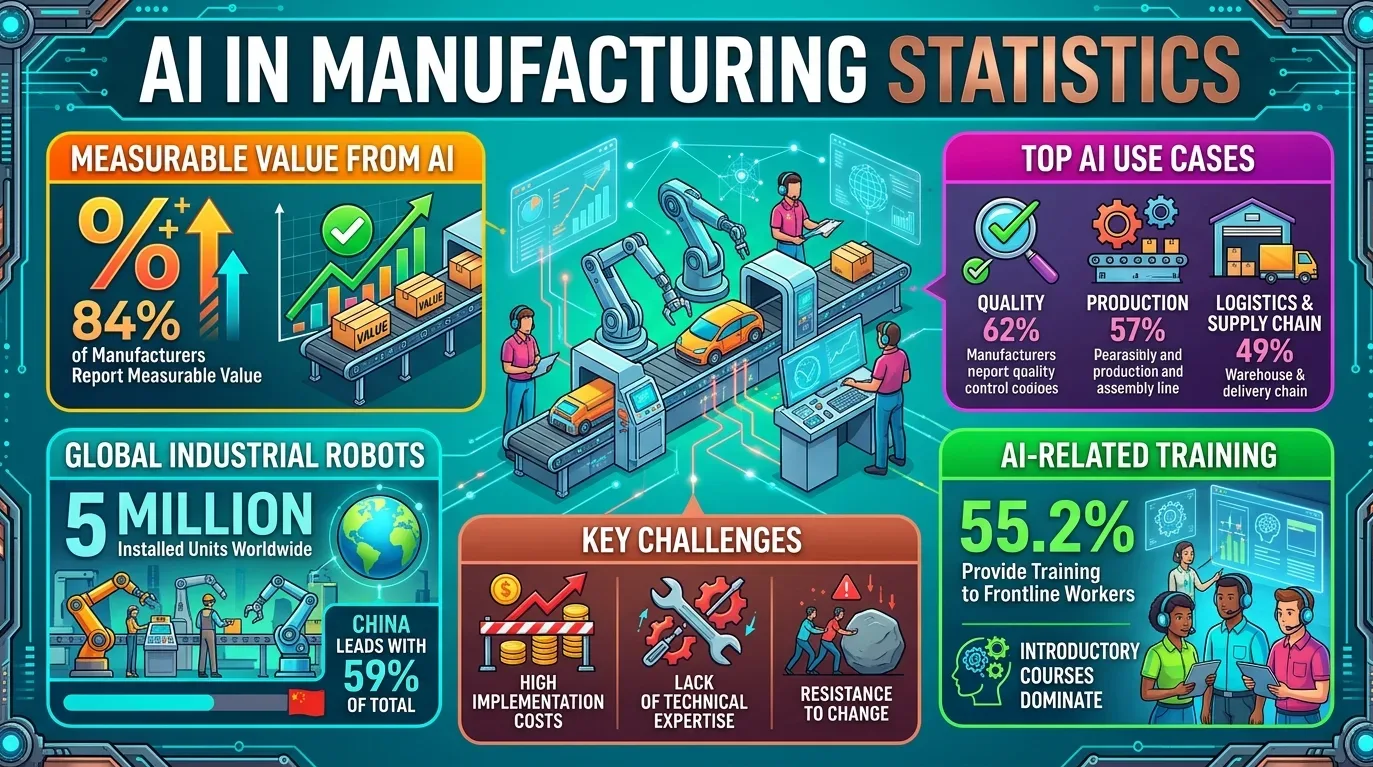
Deloitte’s AI in Manufacturing 2026 survey found 84% of manufacturers getting measurable value from AI, yet only about one in five use cases had scaled across sites. This set of AI in manufacturing statistics covers 2026 market estimates from three research firms, adoption and ROI data from Deloitte and Rockwell Automation, U.S. workforce training figures from NAM, and IFR’s count of robots installed in 2025.
AI in Manufacturing Statistics
How Big Is the AI in Manufacturing Market in 2026?
Three research firms place the 2026 market between $9.85 billion and $12.35 billion. Each uses its own scope and forecast window, so the long-range figures split far apart.
| Research firm | 2025 | 2026 | Long-range forecast | CAGR |
|---|---|---|---|---|
| Fortune Business Insights | 7.60B | 9.85B | $128.81B by 2034 | 37.90% (2026-2034) |
| Straits Research | 8.10B | 11.31B | $163.10B by 2034 | 39.60% (2026-2034) |
| Precedence Research | 8.57B | 12.35B | $287.27B by 2035 | 42.08% (2026-2035) |
Source: Fortune Business Insights, Straits Research and Precedence Research, 2026 report editions (vendor revenue estimates)
Straits Research’s own page carries a second set of numbers. Its key-takeaways box lists $11.4 billion for 2026 and $168.1 billion for 2034.
Broader definitions produce larger totals. A MarketsandMarkets report released through ResearchAndMarkets in October 2025 valued the market at $34.18 billion in 2025, with $155.04 billion projected for 2030.
Source: ResearchAndMarkets via Business Wire, October 2025
The same scope gap shows up across AI categories, including the spread in multimodal AI market estimates.
Which Segments Lead the AI in Manufacturing Market?
Hardware holds 45.89% of 2026 revenue in Fortune Business Insights’ model. Machine learning leads the technology split at 40.10%.
The chip and server spending behind that hardware lead is tracked in our AI hardware market share figures.
Precedence Research cuts the market by industry. It expects medical devices to hold the largest share from 2026 to 2035.
Source: Fortune Business Insights, 2026 edition; Precedence Research, January 2026 update
Regional AI in Manufacturing Market Share and Country Values
Asia Pacific held 42.80% of 2025 revenue, or 3.25billion,inFortuneBusinessInsights’estimate.NorthAmericafollowedat28.70%(2.18 billion) and Europe at 20.70% ($1.58 billion).
Precedence Research ranks the regions differently. It names North America the largest market in 2025.
| Country | 2026 projected market value |
|---|---|
| United States | $1.99B |
| China | $1.80B |
| Japan | $0.80B |
| India | $0.76B |
| Germany | $0.63B |
| United Kingdom | $0.54B |
Source: Fortune Business Insights, 2026 projections
The U.S. leads the published country figures, with China $0.19 billion behind. Country-level AI research output is compared in our AI patent filing statistics by country.
84% Report Value, but Only One in Five AI Use Cases Scale
Deloitte surveyed more than 140 manufacturers across industries, regions and company sizes for its AI in Manufacturing 2026 study. Around 84% reported measurable value from AI in their operations.
Scale is the gap. Only about one in five use cases had been rolled out consistently across sites or enterprise-wide. Average improvement potential across core KPIs sat near 20%.
Source: Deloitte, AI in Manufacturing 2026 survey
Rockwell Automation’s 11th State of Smart Manufacturing report, released May 19, 2026, polled 1,560 respondents in 17 countries. It found 34% of operations AI-augmented today. Respondents expect more than half to be AI-supported by 2030.
| Finding | Share of respondents |
|---|---|
| Say digital transformation is essential to compete | 90% |
| Actively use smart manufacturing technologies in operations | 59% |
| Remain in pilot mode | 18% |
Source: Rockwell Automation, 2026 State of Smart Manufacturing Report
Data use trails data collection. Respondents said only 43% of the data they gather is used effectively, while one-third of operating budgets stays committed to industrial technology.
Where Do Factories Deploy AI First?
Quality leads at 62% of Deloitte respondents. Production follows at 57%, then logistics and supply chain at 49%. The shares overlap and do not sum to 100%.
Source: Deloitte, AI in Manufacturing 2026 survey
Which AI Technologies Are Factories Using?
Machine learning and deep learning top Deloitte’s 2026 technology list at 42% of respondents. Generative AI and agentic AI, counted as one category, follow at 40%. For a cross-sector view, see these generative AI adoption rates.
Physical AI and closed-loop systems reach 18% of respondents. Agent deployment outside factories is tracked in our AI agent adoption statistics.
Source: Deloitte, AI in Manufacturing 2026 survey
AI in Manufacturing ROI Potential by KPI
Equipment availability in process manufacturing shows the highest reported KPI improvement potential, at 27%. Cycle time per unit sits at 21% in both process and discrete plants.
| Manufacturing type | Process area | Improvement potential |
|---|---|---|
| Process | Chemical / physical transformation | 32% |
| Process | Packaging and quality control | 23% |
| Process | Formulation and finishing | 19% |
| Discrete | Assembly | 22% |
| Discrete | Primary shaping | 21% |
| Discrete | Changing material properties | 19% |
Source: Deloitte, AI in Manufacturing 2026 survey
Deloitte ties the largest gains to processes with high variability and many interacting parameters. Chemical and physical transformation, at 32%, tops every area it lists.
AI in Manufacturing Challenges: Cost, Risk and Skills
High implementation cost is the most cited barrier in Deloitte’s 2026 survey, named by 43% of respondents.
| Implementation challenge | Share of respondents |
|---|---|
| High implementation costs | 43% |
| Lack of technical expertise | 35% |
| Resistance to change | 35% |
| Regulatory / compliance concerns | 34% |
| Data availability or quality issues | 30% |
Source: Deloitte, AI in Manufacturing 2026 survey
Risk concerns center on live operations. 79% of respondents cited operational disruption and 51% cybersecurity and data protection, ahead of user acceptance (29%), compliance exposure (27%) and model reliability (15%).
Rockwell’s 2026 report found 46% of manufacturers had at least one cyber incident in the past year. Board-level AI incident data sits in our AI safety incident reporting statistics.
U.S. cost pressure adds to the list. In NAM’s Q2 2026 survey, 83.1% of respondents cited increased raw material costs and 71.8% trade uncertainties. Among large manufacturers, 86% named trade uncertainties their top challenge.
Source: NAM Manufacturers’ Outlook Survey, Q2 2026 (215 responses, May 12-28, 2026; multiple answers allowed)
How Are U.S. Manufacturers Training Workers for AI?
More than half of NAM’s Q2 2026 respondents (55.2%) provide AI-related training to frontline workers. Introductory courses dominate among firms that offer it.
| Training type | Share of firms providing AI training |
|---|---|
| Introductory or awareness-level | 78.5% |
| Data, analytics or interpreting AI outputs | 49.5% |
| Using AI for quality, production, maintenance or logistics | 42.1% |
| Operating AI-enabled machines, equipment or software | 36.4% |
| Advanced or role-specific | 26.2% |
Source: NAM Manufacturers’ Outlook Survey, Q2 2026; multiple answers allowed
NAM also asked what AI skill level frontline workers will need. Among respondents who gave a definite answer, foundational, practical skills ranked first at 39.6%, and only 6.7% chose advanced technical skills.
The sample comes from NAM’s own members, and 22.64% of respondents said it was too early to judge. Job cuts linked to AI are tracked in our AI job displacement statistics by industry.
Source: NAM Manufacturers’ Outlook Survey, Q2 2026
Five Million Industrial Robots Now Operate Worldwide
IFR’s World Robotics 2026 report puts the global operational stock at a record 5 million units in 2025, up 9%. Annual installations rose 11% to more than 600,000.
China installed 354,000 units, 59% of the global total. Chinese suppliers sold 195,000 of them, a 55% home-market share, down from 57% in 2024.
The United States passed Japan to rank second, with almost 38,500 installations (+12%). Japan fell 19% to 36,219 units.
India grew 15% to almost 10,500 units and averaged 27% annual growth from 2020 to 2025.
| Market | 2025 installations | Change vs 2024 |
|---|---|---|
| Italy | About 7,800 | -11% |
| Mexico | Fewer than 5,200 | -7% |
| France | Almost 4,500 | -8% |
| Brazil | Almost 4,300 | +38% |
| Spain | About 4,300 | -15% |
| Canada | Almost 4,000 | +5% |
Source: IFR, World Robotics 2026, 2025 installations
IFR forecasts 655,000 installations in 2026 and 806,000 in 2029. It cites advances in AI, machine vision and sensing as widening the range of viable robot applications.
Source: IFR, World Robotics 2026 outlook (published September 24, 2026)
FAQs
How big is the AI in manufacturing market?
Estimates for 2026 range from $9.85 billion (Fortune Business Insights) to $12.35 billion (Precedence Research), with Straits Research at $11.31 billion. Each firm applies its own market scope.
How many manufacturers use AI?
Deloitte’s 2026 survey of more than 140 manufacturers found 84% get measurable value from AI. Rockwell Automation’s 2026 report puts the share of operations that are AI-augmented at 34%.
What is AI used for most in manufacturing?
Quality. Deloitte’s 2026 survey found 62% of respondents deploy AI in quality, ahead of production at 57% and logistics and supply chain at 49%.
Reddit threads say most factory AI projects never leave the pilot stage. Is that true?
Partly. Deloitte’s 2026 survey found only about one in five AI use cases scaled across sites or enterprise-wide. Rockwell’s 2026 report found 18% of manufacturers still in pilot mode.
Which country installs the most industrial robots?
China. It installed 354,000 industrial robots in 2025, 59% of the global total, according to IFR’s World Robotics 2026 report. The United States ranked second with almost 38,500 units.
References
https://www.deloitte.com/de/de/Industries/industrial-construction/research/ai-in-manufacturing.html
https://ifr.org/ifr-press-releases/news/five-million-robots-now-operate-in-factories-globally
https://nam.org/wp-content/uploads/securepdfs/2026/06/NAM_2026_Q2_Outlook_Survey_Writeup.pdf
