


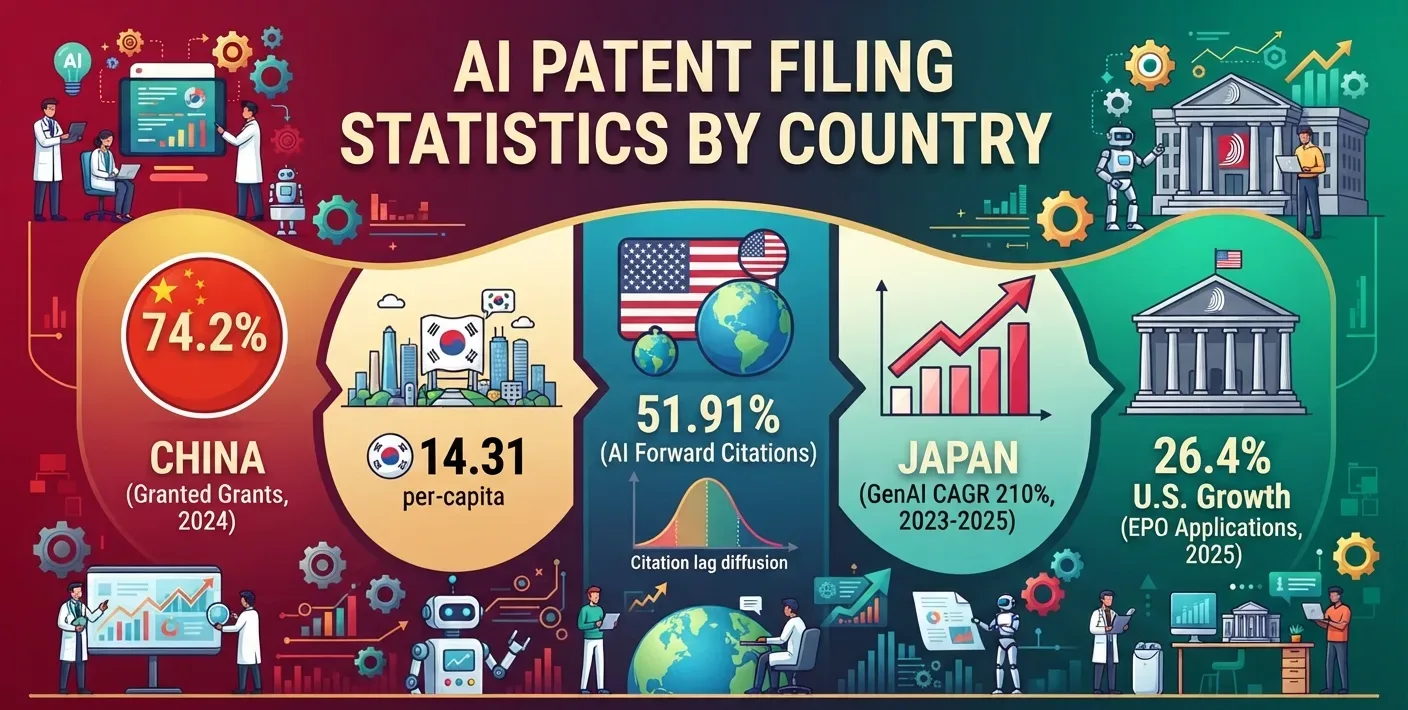
China received 74.2% of the AI patents granted worldwide in 2024, yet South Korea had the most per person. Both figures come from the same Stanford dataset. This page sets out AI patent statistics by country across three counts that should not be mixed: granted patents (Stanford AI Index 2026), generative AI patent families by inventor location (WIPO, July 2026), and applications filed at the European Patent Office in 2025.
AI Patent Filing Statistics by Country
Which Country Has the Most AI Patents? China Holds 74.2% of 2024 Grants
China accounted for 74.2% of the 131,121 AI patents granted worldwide in 2024, based on the Stanford AI Index 2026. The index draws on the EPO’s PATSTAT Global database.
The United States ranked second at 12.1%. Europe followed at 3% and India at 0.4%, with 10.35% going to the rest of the world.
Global AI patent grants rose 8.2% between 2023 and 2024. The 2010 total was 3,866.
The U.S. share has declined since peaking at 42.8% in 2015. China’s share rose from under 20% over the same decade.
Grants count what offices approved, not what applicants filed. The WIPO and EPO sections below measure filings and publications instead.
Source: Stanford HAI, AI Index Report 2026, Chapter 1 (granted AI patents, 2024)
AI Patent Statistics by Country per Capita: South Korea at 14.31
South Korea recorded 14.31 granted AI patents per 100,000 inhabitants in 2024, the top rate in Stanford’s per-capita ranking. Luxembourg placed second at 12.25.
China ranked third at 6.95, about half the Korean rate. The United States (4.68) and Japan (4.30) came next.
Germany, at 1.31, is the second-highest European country on the list after Luxembourg. Switzerland sits last among the 15 countries shown, at 0.21.
Source: Stanford HAI, AI Index Report 2026 (granted AI patents per 100,000 inhabitants, 2024)
U.S. Patents Draw 51.91% of AI Forward Citations
U.S. AI patents received 51.91% of all forward citations to AI patents granted between 2010 and 2024, per Stanford. China ranked second at 29.81%, well below its share of grants.
A forward citation is a later patent referencing an earlier one. Stanford notes the link between citations and technological impact has been questioned, and that most citations stay within the same country.
The flows are not symmetric. Stanford reports that Chinese patents are cited often in U.S. filings, while U.S. patents appear far less often in Chinese ones.
How Fast AI Patents From Each Country Get Cited
Most AI patents receive a first citation within two to three years. Stanford’s diffusion curve shows how many remain uncited.
| Geographic area | Share of AI patents not yet cited |
|---|---|
| United States | 19% |
| Japan | 32% |
| Europe | 35% |
| South Korea | 42% |
| China | 44% |
| Rest of the world | 44% |
Source: Stanford HAI, AI Index Report 2026 (forward citations and citation lag, AI patents granted 2010–2024)
Generative AI Patent Filings by Country, 2023 to 2025
China-based inventors published more than 43,000 GenAI patent families in 2024 and 2025, above China’s entire 2014–2023 output. That figure comes from WIPO’s Patent Trends Update in GenAI, published in July 2026.
China’s compound annual growth rate was 64% between 2023 and 2025. WIPO says several countries posted higher rates, narrowing the gap in relative terms while China kept the volume lead.
| Rank | Inventor location | CAGR, 2023–2025 | Published GenAI families |
|---|---|---|---|
| 1 | China | 64% | 43,000+ (2024 and 2025 combined) |
| 2 | United States | 92% | About 1,185 (2023); over 4,380 (2025) |
| 3 | Japan | 210% | 398 (2023); 3,835 (2025) |
| 4 | Republic of Korea | 21% | Not published |
| 5 | India | 63% | Not published |
| 6 | Germany | 85% | Not published |
| 8 | United Kingdom | 69% | Not published |
Source: WIPO, Patent Trends Update in GenAI (July 2026), published patent families by inventor location, 2023–2025
WIPO notes that some families list inventors from more than one country, so country totals overlap. Canada (109%) and Switzerland (124%) also posted high growth; WIPO did not publish their ranks.
Japan’s 210% Jump and the SoftBank Effect
Japan moved from fourth to third place, overtaking the Republic of Korea. WIPO attributes most of the rise to SoftBank, which published nearly 3,000 GenAI families in 2024 and 2025.
Without SoftBank, WIPO says Japan’s growth would be “significantly more modest.” Korea’s 21% was the lowest of the nine CAGRs WIPO published.
Germany, in sixth place, has overtaken the United Kingdom (eighth) as the leading European inventor location for GenAI. Patent counts track inventions, not usage, which is measured separately in these generative AI adoption rates.
Source: WIPO, Patent Trends Update in GenAI (July 2026)
How Many GenAI Patents Are Filed in More Than One Country?
International patent families, published in two or more jurisdictions, grew from 1,931 in 2023 to 3,297 in 2025. They made up about 9% of GenAI family publications in 2025.
WIPO links the low share partly to China, whose applicants typically file most patents domestically. Young portfolios play a part too, since applicants often add jurisdictions later.
GenAI families made up 8.7% of the more than 435,000 AI patent family publications in 2025. That share was 6.1% in 2023 and 4.2% in 2017.
Worldwide, GenAI families went from 18,862 in 2024 to 37,808 in 2025. More than 56,000 were published across those two years, above the 2014–2023 total.
Large language model families passed 14,100 in 2025, against 5,245 for GANs. WIPO ties this to the commercial success of LLM products; chatbot deployment is tracked in these conversational AI market statistics.
Software and code families rose from 339 in 2023 to 1,616 in 2025, a category close to tools covered in these Cursor AI statistics. WIPO lists Alphabet and Nvidia among early filers on agentic AI, and company rollouts appear in these AI agent adoption figures.
Source: WIPO, Patent Trends Update in GenAI (July 2026), published patent families, 2017–2025
Six of the Top 10 GenAI Patent Owners Are Chinese
| Rank | Owner | Home country | GenAI families, 2014–2025 |
|---|---|---|---|
| 1 | SoftBank | Japan | 2,985 |
| 2 | Tencent Holdings | China | 2,702 |
| 3 | Ping An Insurance Group | China | 2,240 |
| 4 | Baidu | China | 1,902 |
| 5 | Chinese Academy of Sciences | China | 1,396 |
| 6 | State Grid Corporation of China | China | 1,144 |
| 7 | Alphabet | United States | 1,083 |
| 8 | Zhejiang University | China | 903 |
| 9 | Microsoft | United States | 865 |
| 10 | IBM | United States | 821 |
Source: WIPO, Patent Trends Update in GenAI (July 2026), published patent families, 2014–2025
SoftBank’s families were published between 2014 and 2025, and nearly all were filed in 2023 and published in 2025. State Grid published 853 of its 1,144 families in 2024 and 2025.
Alphabet is the largest U.S.-based owner, with 640 families in 2024 or 2025. Samsung Electronics (777) is the only Korean owner in WIPO’s top 25, and Bosch (368) the only German one.
OpenAI held 35 patent filings globally as of late 2025, according to WIPO.
EPO AI Patent Filing Statistics by Country of Origin in 2025
AI-related applications at the European Patent Office rose 9.5% in 2025. They sit inside computer technology, the office’s largest field, which grew 6.1%.
European applicants held the largest share of AI applications and increased them 2.6%. Applicants from China made up 12% of all AI applications at the office.
U.S. applicants filed 799 AI applications, up 26.4% from 632 in 2024. The EPO says that was the highest growth of all major patent filing countries.
The table below covers all technologies, not AI alone.
| Country of origin | EPO applications, 2025 (all fields) | Change vs 2024 |
|---|---|---|
| United States | 47,008 | -1.6% |
| Germany | 24,476 | -2.2% |
| China | 22,031 | +9.7% |
| Republic of Korea | 14,355 | +9.5% |
Source: European Patent Office, Technology Dashboard 2025 (applications filed in 2025)
China overtook Japan (+1.1%) for third place for the first time. Total EPO applications reached 201,974, up 1.4%.
FAQs
Which country has the most AI patents?
China. It accounted for 74.2% of the 131,121 AI patents granted worldwide in 2024, according to Stanford’s 2026 AI Index. The United States ranked second at 12.1%.
Which country has the most AI patents per capita?
South Korea, with 14.31 granted AI patents per 100,000 inhabitants in 2024. Luxembourg followed at 12.25 and China at 6.95, per the Stanford AI Index 2026.
Which country’s generative AI patent filings grew fastest?
Japan, at a 210% compound annual growth rate in GenAI patent families from 2023 to 2025. WIPO says it was the highest among top inventor locations, driven largely by SoftBank.
How many AI patent applications did the US file at the EPO?
U.S. applicants filed 799 AI-related applications at the European Patent Office in 2025, up from 632 in 2024. The EPO says that 26.4% rise was the highest among major filing countries.
What numbers should I use when comparing US and China AI patents on Reddit?
Use two Stanford AI Index 2026 figures: China held 74.2% of AI patents granted in 2024, while U.S. patents drew 51.91% of forward citations to AI patents granted 2010–2024. One measures volume, the other citations.
Sources
https://hai.stanford.edu/ai-index/2026-ai-index-report/research-and-development
https://www.epo.org/en/about-us/statistics/technology-dashboard-2025
