


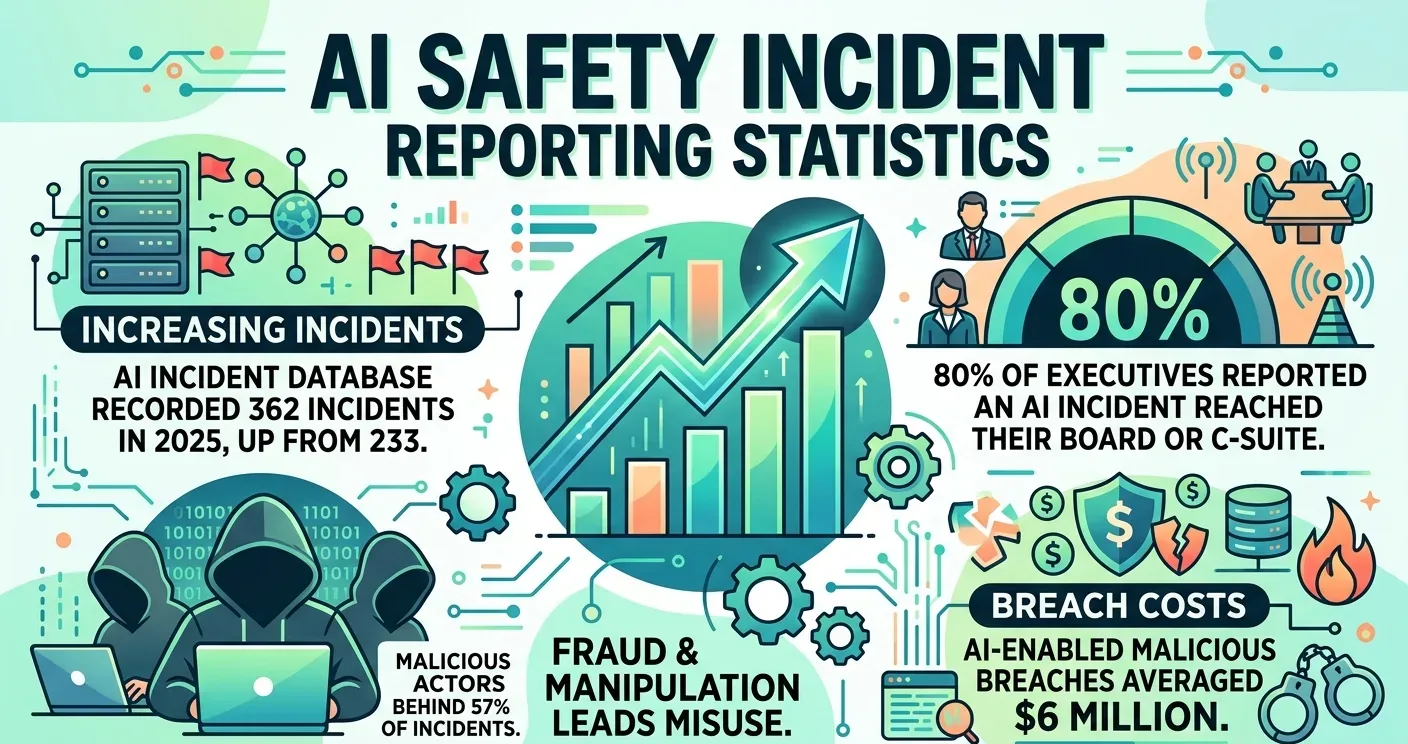
Eight in ten executives in IBM’s September 2026 EMEA survey said an AI-related incident reached their board or C-suite in the past year. Public trackers rose too, with the AI Incident Database recording 362 incidents in 2025, up from 233 in 2024.
These AI safety incident reporting statistics cover tracker counts, legal deadlines, company incident logs, causes and breach costs.
AI Safety Incident Reporting Statistics
How Many AI Safety Incidents Were Reported in 2025?
The AI Incident Database (AIID) recorded 362 AI incidents in 2025, up from 233 in 2024, according to Stanford HAI’s 2026 AI Index.
Source: Stanford HAI, 2026 AI Index (AIID data), 2024–2025
OECD’s AI Incidents and Hazards Monitor (AIM) works at a larger scale. It logged 435 incidents in January 2026, its peak month, and a six-month moving average of 326.
Source: Stanford HAI, 2026 AI Index (OECD AIM data), January 2026
AIM’s all-time count stood at about 18,340 incidents and hazards on October 15, 2026. OECD says incidents have fallen as a share of all AI news.
Source: OECD AI Incidents and Hazards Monitor, October 15, 2026
Why do AIID and OECD AIM counts differ?
The AIID takes public submissions, and editors check each one against a threshold of AI involvement. The AI Index says this slows additions and tilts coverage toward English-language, high-visibility cases.
AIM uses an automated, multilingual news pipeline, and one AIM entry can draw on several articles about the same event.
One 2025 case in the AI Index: xAI’s Grok produced antisemitic content in July 2025 after an update relaxed its safety filters, and xAI paused its text responses.
72 Hours, 15 Days, 2 Days: AI Safety Incident Reporting Rules
Of the three frameworks below, New York sets the shortest standard window. Governor Hochul’s office said the RAISE Act, signed December 19, 2025, requires incident reports to the State within 72 hours.
| Framework | Who reports | Standard deadline | Faster deadline | Report goes to |
|---|---|---|---|---|
| EU AI Act, Article 73 | Providers of high-risk AI systems | 15 days | 2 days for widespread infringement or critical infrastructure disruption; 10 days after a death | Market surveillance authorities where the incident occurred |
| California SB 53 | Frontier developers | 15 days | 24 hours for imminent risk of death or serious physical injury | Cal OES; 24-hour cases to an appropriate authority such as law enforcement |
| New York RAISE Act (S8828 text) | Frontier developers | 72 hours | 24 hours for imminent risk of death or serious physical injury | DFS office; 24-hour cases to an appropriate authority |
Source: Regulation (EU) 2024/1689, Article 73; California SB 53, 2025; New York S8828 bill text, January 2026
California caps civil penalties at $1 million per violation for large frontier developers. New York allows up to $1 million for a first violation and $3 million for each later one.
Source: California SB 53, 2025; Office of the Governor of New York, December 19, 2025
Both states accept public reports. SB 53 tells Cal OES to run a channel for frontier developers or members of the public, with its first anonymized annual report due January 1, 2027.
New York’s S8828 text gives a DFS office the same public channel, a January 1, 2027 start date and a first annual incident report on January 1, 2028.
Source: California SB 53, 2025; New York S8828 bill text, January 2026
AI Incidents per Organization, McKinsey 2024 vs 2025
The share of organizations in the McKinsey survey reporting AI incidents held at 8% in 2024 and 2025, per the AI Index. The survey excludes China.
Among organizations with incidents, the share logging three to five rose from 30% to 50%. The one-to-two group fell from 42% to 29%.
Source: McKinsey & Company survey via Stanford HAI 2026 AI Index, 2024–2025
Responsible AI spending, one line in enterprise AI budgets, is highest at the largest firms. Among organizations with $30 billion or more in revenue, 41% expected to spend $25 million or more.
Source: McKinsey & Company survey via Stanford HAI 2026 AI Index, 2025
How do companies rate their AI incident response?
| Self-rated response | 2024 | 2025 |
|---|---|---|
| Excellent | 28% | 18% |
| Good | 39% | 24% |
| Satisfactory | 19% | 32% |
| Needs improvement | 13% | 21% |
| Insufficient | 2% | 5% |
| Unknown | 0% | 0% |
Source: McKinsey & Company survey via Stanford HAI 2026 AI Index, 2024–2025 (rounded by the source)
Excellent ratings fell 10 points and good ratings 15 points. Satisfactory became the most common answer in 2025, at 32%.
Do AI Incidents Reach the Board? IBM’s September 2026 Survey
For most respondents, yes. Of 3,221 executives at organizations with 1,000 or more employees in eight European and Middle East countries, 80% said an AI-related incident reached their board or C-suite in the past year.
Source: IBM survey by Censuswide, fielded September 14–24, 2026
IBM’s definition includes agent failures, data exposure, AI-driven decision errors and AI security breaches. Of the firms where an incident reached leadership, 40% changed AI governance policy or frameworks in response.
Ownership of agent failures is split, even though 35% of respondents run agentic AI in production. CIOs or CTOs were the most-cited owner of adverse AI agent outcomes, named by 17%.
| Governance measure | Share of respondents |
|---|---|
| Assigned AI risk responsibility at board level | 98% |
| Run agentic AI in production | 35% |
| Governance designed to scale with agentic AI | 37% |
| Board-reviewed estimate of financial risk from AI governance gaps | 37% |
| Monitor third-party AI risk on a continuous basis | 21% |
Source: IBM, The New Realities of AI Governance survey, September 2026
Malicious Actors Behind 57% of 2025 AI Safety Incident Reports
| MIT classification (full dataset) | Share of reported incidents |
|---|---|
| Malicious actors (risk domain) | 35% |
| AI system safety, failures, & limitations (risk domain) | 22% |
| Tagged as intentionally caused | 51% |
| Classified as pre-deployment | 2% |
| EU AI Act level 1 (Unacceptable) | 3% |
| EU AI Act level 2 (High Risk) | 35% |
Source: MIT AI Incident Tracker, full dataset of classified AIID records, accessed October 2026
Deepfake video generation is the primary-purpose category tied to the most incidents in MIT’s classification of AIID records.
Misuse weighs heavier in recent records. MIT attributes 57% of incidents reported in 2025 to malicious actors, against 35% across the full dataset.
Fraud leads the misuse domain, with 329 of its 426 incidents classed as fraud, scams and targeted manipulation.
Source: MIT AI Incident Tracker, 2025 records and full dataset
Which Reported AI Risks Get Mitigated?
Inaccuracy topped the 2025 McKinsey risk list, rated relevant by 74% of respondents, up from 60% in 2024. Active mitigation reached 71%.
Benchmarks track the same problem at the model level. Across 26 models on AA-Omniscience, hallucination rates ranged from 22% to 94%, and the AI Index notes growing demand for AI in higher-stakes settings such as law and medicine.
Source: McKinsey & Company survey and Artificial Analysis, via Stanford HAI 2026 AI Index
Autonomous or unintended system actions, a new option in 2025, drew 44% relevance and 29% active mitigation.
Source: McKinsey & Company survey via Stanford HAI 2026 AI Index, 2025
Breach Costs Tied to AI in IBM’s 2026 Study
IBM’s 2026 Cost of a Data Breach Report put the global average breach at $4.99 million, up 12% and a record for the report. One in four malicious breaches were AI-enabled, a 56% increase, and those averaged $6 million.
Model inversion attacks averaged $6.07 million per breach and prompt injection attacks $5.89 million, per IBM X-Force.
Source: IBM and Ponemon Institute, Cost of a Data Breach Report 2026 (602 organizations breached March 2025–February 2026)
More than 20% of organizations reported a breach targeting AI models or applications, and 92% of those lacked proper AI access controls.
The most common causes were compromised APIs, applications or plug-ins (27%) and cloud misconfigurations affecting AI workloads (27%).
Source: IBM press release and X-Force analysis, July 29, 2026
FAQs
How many AI incidents were reported in 2025?
The AI Incident Database recorded 362 AI incidents in 2025, up from 233 in 2024, per Stanford HAI’s 2026 AI Index. OECD’s automated monitor peaked at 435 incidents in January 2026.
How quickly must AI safety incidents be reported?
Deadlines depend on the law. New York requires 72 hours, while California SB 53 and the EU AI Act allow up to 15 days. Imminent risk to life triggers 24-hour reporting in both states.
Who receives AI incident reports in California?
Cal OES receives critical safety incident reports from frontier developers. Incidents posing imminent risk of death or serious physical injury go to an appropriate authority, such as law enforcement, within 24 hours.
Can Reddit users report AI safety incidents to regulators?
Yes, in some states. SB 53 requires Cal OES to offer a public reporting channel, and New York’s S8828 text sets one up at DFS. The AI Incident Database also takes public submissions.
Are most reported AI incidents caused by misuse?
Recent ones are. MIT attributes 57% of incidents reported in 2025 to malicious actors, versus 35% across its full dataset, where AI system safety, failures and limitations account for 22%.
