


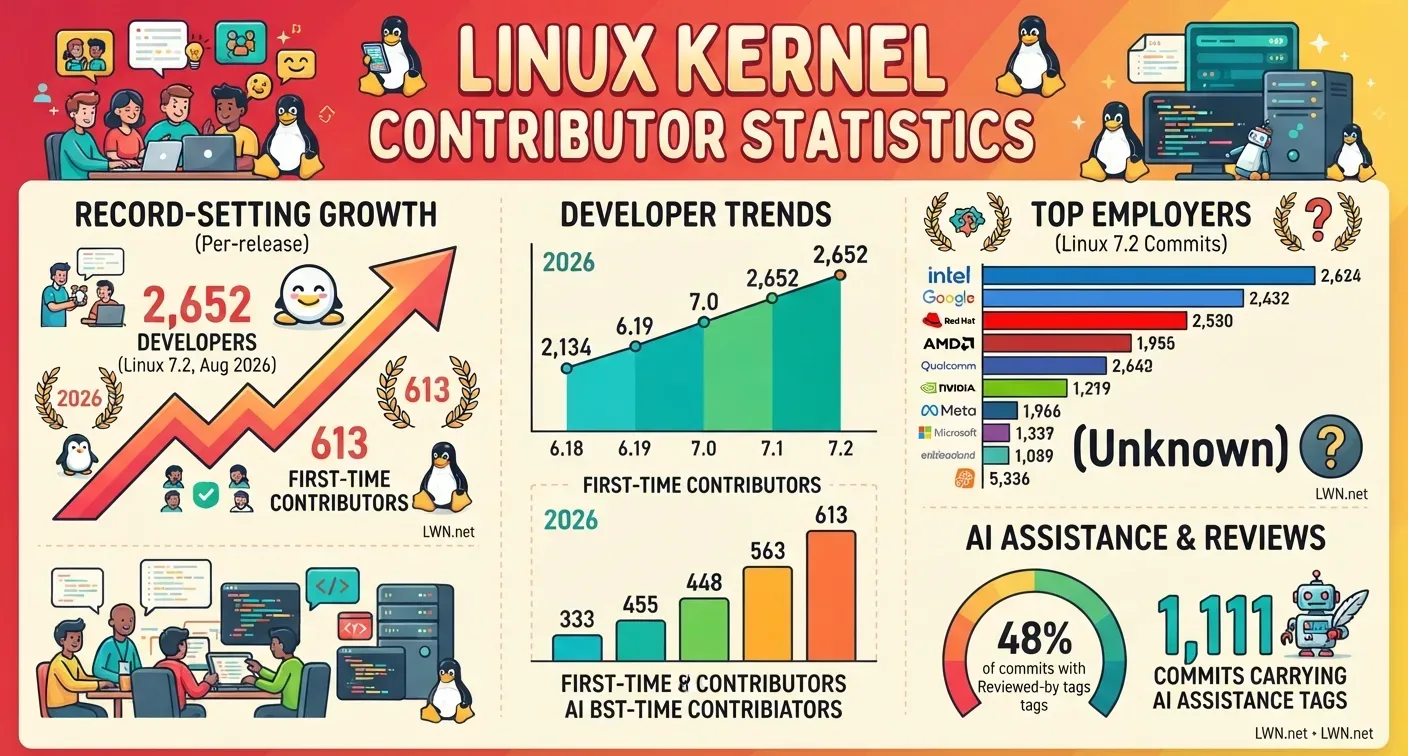
Linux 7.2 took code from 2,652 developers; Linux 6.18, released in November 2025, drew 2,134. These Linux kernel contributor statistics follow that climb across five releases using LWN.net’s per-release counts.
The data covers newcomers, employers, maintainer sign-offs, declared AI assistance, review tags and commit volume, each tied to its release.
Linux Kernel Contributor Statistics
How Many Developers Contribute to a Linux Kernel Release?
Linux 7.2, released August 17, 2026, carried work from 2,652 developers. LWN.net called it a big increase over the previous record of 2,479, set by 7.1 in June.
All five releases from 6.18 to 7.2 set a new developer record. The smallest step came in 6.19, which beat 6.18 by 2,141 to 2,134.
| Release | Released | Developers | First-time contributors |
|---|---|---|---|
| 6.18 | November 30, 2025 | 2,134 | 333 |
| 6.19 | February 8, 2026 | 2,141 | 333 |
| 7.0 | April 12, 2026 | 2,362 | 489 |
| 7.1 | June 14, 2026 | 2,479 | 530 |
| 7.2 | August 17, 2026 | 2,652 | 613 |
LWN’s own reports disagree on one point. The 7.0 article gave 2,134 as the 6.19 record, while the 6.19 article lists 2,141 for 6.19 and 2,134 for 6.18.
Contributors Across the 2025 LTS Cycle
The six releases from 6.13 to 6.18 merged 80,035 non-merge changesets from 5,275 developers. LWN identified 372 employers across that stretch.
613 First-Time Contributors Joined in Linux 7.2
Linux 7.2 counted 613 developers whose first kernel patch landed in that release. That broke the records set by 7.0 (489) and 7.1 (530).
The 2025 benchmark was 335 newcomers in 6.12. Both 6.18 and 6.19 recorded 333.
LWN’s 7.1 report linked the surge to wider access to LLM-based development tools. It also noted that many contributors ignore the kernel’s rules for disclosing that use.
Bryam Vargas was the most active 7.2 newcomer, with 43 commits spanning NVMe, F2FS, SELinux, Thunderbolt and other subsystems. In 7.1, Michael Bommarito led newcomers with 60 commits, almost all carrying Assisted-by tags.
Where Did 7.1 Newcomers Send Patches?
Documentation drew 78 first-time developers in 7.1, ahead of the net subsystem at 66. LWN counts developers per subsystem, so the rows are not shares of the 530 total.
At least 132 of the 7.1 newcomers could already be tied to an employer, across 51 companies. Qualcomm employed 15, AMD 14 and Google 12.
Five newcomers touched Rust files, just under 1% of the group.
How Long Do New Kernel Contributors Stay?
LWN tracked 5,424 developers who first contributed to a 5.x kernel between early 2019 and mid-2022. Of those, 1,943 (36%) never appeared in another release.
Another 883 (16%) returned for one more release, and 32% contributed to at least four. Just under 20%, or 1,067 developers, still contributed to a 2025 release.
How AI Shows Up in Linux Kernel Contributor Statistics
1,111 commits in Linux 7.2 carried Assisted-by tags declaring AI tool use, under 7% of the release. Linux 7.0 had 31 such commits.
The 7.1 figure depends on the report. LWN’s 7.1 article counted 299, and its 7.2 article cites 301.
LWN expects the real number of LLM-assisted patches to be far higher. Many developers omit the tag, and at least one maintainer strips it when applying patches.
Rosen Penev ranked second by 7.2 commits with 146, which LWN describes as LLM-authored bug fixes across architecture, driver, networking and crypto code.
AI tools also appear on the review side. 252 commits in 7.2 credit the Sashiko review system in Reported-by tags, and 568 mention Sashiko in their changelogs.
Commits with Fixes tags reached 4,830 in 7.2. LWN ties the sharp recent rise to people turning LLMs toward finding bugs in existing code.
At the 7.2 release, nearly 14,000 changesets sat in linux-next awaiting 7.3. More than 1,100 of them carried Assisted-by tags.
Review and Test Tags by Release
48%
48% of 7.2 commits carried Reviewed-by tags, down from 56% in 6.19. LWN says it is unclear whether that decline reflects less actual review.
| Release | Commits with Reviewed-by tags | Commits with Tested-by tags |
|---|---|---|
| 6.18 | 53.6% | 9.0% |
| 6.19 | 56% | 10% |
| 7.0 | 54% | 9.4% |
| 7.1 | almost 51% | nearly 8% |
| 7.2 | 48% | just over 8% |
Which Companies Employ Linux Kernel Contributors?
| Employer | Linux 7.2 commits | Share |
|---|---|---|
| (Unknown) | 2,743 | 16.7% |
| Intel | 1,512 | 9.2% |
| 1,191 | 7.3% | |
| Red Hat | 873 | 5.3% |
| AMD | 813 | 5.0% |
| Qualcomm | 767 | 4.7% |
| (None) | 743 | 4.5% |
| NVIDIA | 535 | 3.3% |
| Meta | 441 | 2.7% |
| (Consultant) | 429 | 2.6% |
Intel led named employers in 7.2 with 1,512 commits, ahead of Google at 1,191. The largest single row, though, was (Unknown) at 2,743 commits.
Google also placed third by 7.2 lines changed, at 102,565 (10.3%). Its ChromeOS runs on the Linux kernel, and Linux development on Chromebooks has its own set of figures.
LWN tied the growth of the unknown row partly to the flood of new developers entering the kernel community.
Identified employers rose from 217 in 6.18 to 249 in 7.2, with 227, 225 and 230 in the releases between.
SUSE had 358 commits in 7.2 (2.2%), IBM 307 (1.9%), Oracle 245 (1.5%) and Microsoft 201 (1.2%). Their standing in server operating system share is a separate measure.
Red Hat, with 873 commits (5.3%), is the only Linux distribution vendor in the 7.2 top ten. How distributions rank with visitors and site operators sits in this Linux distro popularity breakdown.
By lines changed, AMD led 7.2 with 224,121 (22.4%). LWN notes the top individual line counts came from machine-generated amdgpu header files.
Maintainer Sign-Offs Show a Different Top Five
Commit counts show who writes patches. Non-author Signed-off-by tags, added by maintainers as they apply others’ work, show who moves patches toward the mainline.
Meta led 6.19 non-author sign-offs with 1,544 (11.8%), followed by Google (9.9%), Intel (9.5%) and Arm (8.9%). By authored commits in the same release, Meta held 2.6%.
In 6.18, just over half of mainline patches passed through maintainers at five companies: two hyperscalers, two CPU makers and Red Hat, according to LWN.
Konrad Dybcio topped 7.2 reviewers with 231 Reviewed-by credits, and Dmitry Baryshkov added 225. LWN says both focus on Qualcomm drivers and devicetree files.
Linux Kernel Contributor Statistics by Commit Volume and Code Size
Linux 7.2 merged 16,418 non-merge commits, the second-busiest release in kernel history per LWN. Only 6.7 brought more, at 17,284, a total LWN ties to the merging of bcachefs development history.
| Release | Non-merge commits |
|---|---|
| 6.18 | 13,710 |
| 6.19 | 14,344 |
| 7.0 | 14,251 |
| 7.1 | 15,849 |
| 7.2 | 16,418 |
Contributor totals do not measure how many people run Linux. Linux desktop share comes from web-traffic trackers that sample pageviews.
Chromebooks add another route through the Crostini Linux container, covered in these Linux usage figures for Chromebooks.
Phoronix counted 40.98 million lines in the tree at Linux 7.3-rc1 using cloc, up from 40.42 million at 7.2. That splits into 30,937,090 lines of code, 4,912,366 comment lines and 5,134,418 blank lines.
The drivers/gpu/drm/amd directory alone held 6.52 million lines, roughly 16% of the kernel. Torvalds said the AMD GPU code and header dump made up about a third of the 7.3-rc1 patch.
FAQs
How many developers contribute to the Linux kernel?
2,652 developers contributed to Linux 7.2, released August 17, 2026, according to LWN.net. That is a per-release record, up from 2,479 in Linux 7.1 two months earlier.
Which company contributes the most to the Linux kernel?
Intel, among named employers. It authored 1,512 of the 16,418 non-merge commits in Linux 7.2 (9.2%), per LWN.net. Developers with unknown affiliation accounted for more, at 2,743 commits (16.7%).
Does Microsoft contribute to the Linux kernel?
Yes. LWN.net credited Microsoft with 201 commits in Linux 7.2, released in August 2026. That equals 1.2% of the release’s 16,418 non-merge commits.
How many lines of code are in the Linux kernel?
Phoronix counted 40.98 million lines at Linux 7.3-rc1 in August 2026, using cloc. That total includes 30,937,090 lines of code, 4,912,366 comment lines and 5,134,418 blank lines.
Are Reddit threads a reliable source for Linux kernel contributor numbers?
Treat them as discussion, not data. Per-release counts come from LWN.net’s development-statistics articles, which draw on its Kernel Source Database. Check the LWN report for the specific release.
Sources
https://lwn.net/Articles/1088776/
https://lwn.net/Articles/1077425/
